
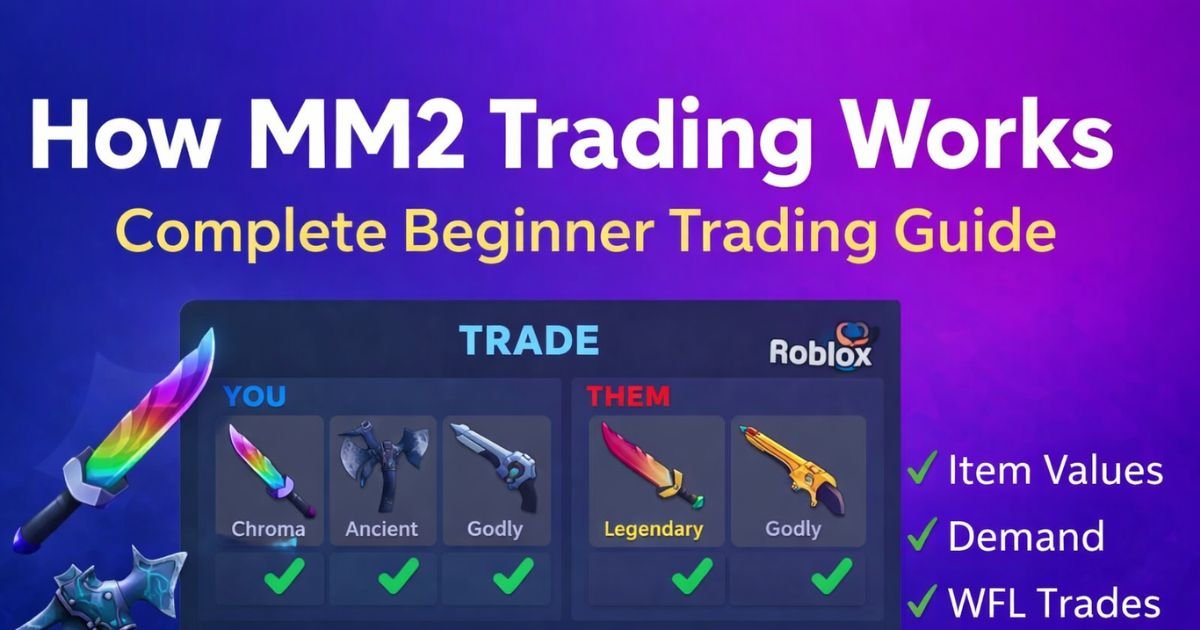
If you just started playing Murder Mystery 2 on Roblox, trading is the single most important skill you can develop. Most new players jump into trades without understanding how the system actually works, and they end up losing good items in the first few days. Once those items are gone, they are gone for good.
Understanding how MM2 trading works is not complicated, but it does require you to slow down and think before accepting anything. Trading in MM2 is not based on luck. It is based on knowing item values, understanding which items are in demand, and being able to judge whether a deal actually benefits you. Players who take the time to learn these basics consistently build stronger inventories than those who just trade randomly.
This guide covers everything from the ground up. You will learn what MM2 trading actually is, how the process works step by step, what item types exist and how they behave in the market, how to judge whether a trade is good or bad, and what experienced traders do differently. By the end, you will have a real understanding of the system and know how to use it to your advantage.
What Is MM2 Trading and Why It Matters
MM2 trading is the process of exchanging weapons, knives, guns, and collectibles with other players to improve your inventory. The goal is not simply to trade for the sake of trading. The goal is to make every exchange move your inventory forward in some way, whether by increasing its total value, improving the demand of your items, or positioning yourself for a better trade in the future.
The reason trading matters so much is that it is the fastest way to grow in Murder Mystery 2. Grinding the game and opening crates can take a very long time and often produces items you already have or do not want. Trading, on the other hand, puts you in direct control. You decide what you give and what you receive. You can be strategic about it.
Here is a simple example that illustrates why trading logic matters more than just counting items:
Player A trades one high-demand godly weapon. Player B offers two items in return. At first glance, Player B seems to be giving more. But if both of Player B’s items are low-demand and hard to trade, Player A is actually the one losing in this deal. The godly weapon Player A gave up could have been traded again easily. The two items Player B offered will sit in an inventory collecting dust.
This is the core lesson of MM2 trading: value and demand are both important, and you must think about both before accepting anything.
Types of Items in MM2 Trading
Not all items behave the same way in the trading market. Understanding the main item categories will help you make smarter decisions and avoid holding items that are difficult to move.
Godly Items
Godly weapons are the foundation of MM2 trading, especially for beginners. They have stable value, consistent demand, and are widely accepted in trades. If you are new to the game, starting your inventory with godly items is the safest approach. They are easier to trade and less likely to drop in value suddenly.
Ancient Items
Ancient items sit above godlies in terms of rarity. However, demand for ancient items can vary depending on the specific item. Some are highly sought after, while others barely move. Before trading for an ancient item, make sure there is real demand for it, not just a high value number on a list.
Chroma Items
Chroma weapons have a color-changing appearance that makes them visually attractive. This attraction often leads beginners to overpay for them. The demand for chroma items can be unstable, meaning their trade value does not always match what people are asking for them. Experienced traders treat chroma items with caution unless the specific item has proven, consistent demand.
Collectibles
Collectibles are limited or event-based items. Their value depends heavily on rarity and history. A collectible from an old event that is no longer available can become extremely valuable over time. However, newer collectibles can be unpredictable. Research the item before committing to a trade involving collectibles.
| Item Type | Demand Level | Stability | Beginner Friendly |
|---|---|---|---|
| Godly | High | Stable | Yes |
| Ancient | Medium | Medium | Moderate |
| Chroma | Medium | Low | Risky |
| Collectible | Varies | High/Low | Depends |
How Item Value Works in MM2
Item value in MM2 is not a fixed number that never changes. It shifts based on several factors working together, and understanding those factors is what separates confident traders from confused ones.
Rarity refers to how difficult an item is to obtain. Items that can no longer be earned or purchased in the game tend to hold or increase in value over time because the supply is fixed while demand continues.
Demand refers to how many players actively want the item. High-demand items are easier to trade because you will almost always find someone interested. Low-demand items are harder to move, even if their listed value is high.
Stability refers to whether the value stays consistent over time or swings up and down. Stable items are safer to hold in your inventory because you will not suddenly find that the item you were counting on is worth much less than it was.
The important insight here is that a rare item is not always a valuable item. If nobody wants it, you cannot trade it. A godly weapon that every trader recognizes and wants will serve you better than an ancient item that looks impressive but nobody is asking for.
For up-to-date item values, check the MM2 Value List – Updated Godly, Ancient and Chroma Values before making any significant trade.
Understanding Demand in MM2 Trading
Demand deserves its own explanation because it is one of the most commonly misunderstood concepts for newer players. Many beginners focus entirely on value numbers and ignore demand completely. This leads to situations where they hold high-value items that they simply cannot trade.
High-demand items have several advantages. They are easy to trade because many players are actively looking for them. They tend to hold their value longer because consistent interest keeps the price stable. In some cases, players will even overpay for high-demand items just to secure them.
Low-demand items create the opposite situation. Even if the value is technically high, you may need to offer additional items just to get someone interested in trading. Over time, this means you are constantly giving more than you should.
Here is a practical scenario to make this concrete. Imagine you receive a trade offer: Option A gives you one high-demand godly weapon. Option B gives you two items that have low demand. Option A is the better choice, even though Option B seems like more. The high-demand godly weapon can be traded again quickly. The two low-demand items may take weeks to move, if they move at all.
You can analyze the demand score of specific items before committing to a deal using the MM2 Demand Calculator – Accurate Trade Score Tool.
What WFL Means and How to Use It Correctly
WFL is one of the most commonly used terms in the MM2 trading community. It stands for Win, Fair, and Lose, and it describes whether a trade benefits you, is neutral, or costs you value.
A Win trade means the items you are receiving are worth more than the items you are giving away. A Fair trade means both sides are exchanging roughly equal value. A Lose trade means you are giving more than you are getting back.
Most experienced traders aim for fair or win trades. They avoid lose trades unless there is a specific strategic reason, such as downgrading intentionally to get items that are easier to move.
However, WFL alone is not enough to judge a trade properly. This is where many beginners make a mistake. They see a trade that checks out as a win on a value calculator and accept it without thinking further. But what if the items you are receiving have low demand? You might win on paper and still end up in a worse position because those items are hard to trade again.
The smart approach combines three checks before accepting any trade. First, is the value fair or in your favor? Second, do the items you are receiving have strong demand? Third, can you realistically trade those items again later? If any of these answers is no, you should think carefully before accepting.
Use the MM2 WFL Calculator – Win Fair Lose Trade Checker to quickly analyze any offer before you commit to it.
How the MM2 Trading Process Works Step by Step
Understanding the actual mechanics of trading will help you feel confident when you are in a trade window. Here is how the process works from start to finish.
Step 1: Finding a Trading Partner
Trading partners are found in trading servers, Roblox trading hubs, community forums, and social media groups dedicated to MM2. Dedicated trading servers are the best place to start because the players there are specifically looking to trade, which means you will find more active offers and faster negotiations.
Step 2: Sending a Trade Request
Once you identify someone who has an item you want or might be interested in what you have, you send a trade request. Both players open the trade window, and each side begins adding items from their inventory. You can see what the other player is offering as they add items, and they can see what you are adding.
Step 3: Evaluating the Trade
Before you accept anything, take a moment to review the trade carefully. Compare the value of items on both sides. Check the demand of every item involved. Think about whether you can actually use the items you are about to receive to make future trades. Experienced traders never rush this step.
Step 4: Confirming the Trade
Once both players are satisfied, they accept the trade. The exchange becomes permanent immediately. There is no undo option in MM2 trading, which is why careful evaluation before confirming is so important.
Real Experience: What Trading Actually Looks Like in Practice
Many guides explain trading concepts in theory but leave out what it actually feels like to navigate real trades. Here is what the experience genuinely looks like for someone building their inventory from scratch.
When you first start trading, you will likely have a small number of items with modest value. The temptation is to go for big trades immediately, but this is where most beginners go wrong. The smarter approach is to start with smaller, low-risk trades. Trade one or two items at a time. Aim for very small wins, not huge leaps.
Over time, this incremental approach compounds. You trade small items for slightly better ones. You combine a few medium items for one higher-value item. You repeat this process. Each step might feel small in the moment, but after a few weeks of consistent, careful trading, your inventory looks completely different.
You will also encounter situations where other players try to pressure you into accepting quickly, or they make the trade sound extremely favorable while actually leaving out key information. Learning to recognize these patterns comes with experience. The more trades you analyze and participate in, the faster your instincts develop.
What separates traders who grow quickly from those who stay stuck is not luck. It is the habit of checking every trade carefully before accepting, staying patient during slow periods, and focusing on demand over raw numbers.
Common Trading Mistakes and How to Avoid Them
Even players who understand the basics make mistakes. Knowing the most common errors helps you recognize them before they cost you something valuable.
Accepting trades too quickly is the most common mistake at every level. When a trade looks exciting or someone is pushing you to decide fast, slow down. Take the time to check the value and demand of every item. A few extra seconds of analysis can prevent a significant loss.
Ignoring demand leads to inventories full of high-value items that cannot be traded. Value and demand work together. An item with no demand is not actually useful to you, no matter what the value list says.
Falling for overpay traps is a scam pattern where someone offers a suspiciously large amount, often more than an item is worth, to attract attention. At the last moment, they swap out the valuable items they showed initially with low-value ones. Always read the trade window carefully before clicking accept, not just when it first opens.
Emotional trading happens when frustration, excitement, or impatience drives your decisions instead of analysis. If you just lost a trade and feel like you need to quickly make it back, or if you are excited about a new item and rush into a deal, your judgment is compromised. The best traders treat every offer the same way, calmly and methodically.
Not checking trade safety means skipping the basic step of verifying whether a trade is risky before agreeing to it. Tools exist to help with this. Use the MM2 Scam Checker Tool – Avoid Murder Mystery 2 Scams when something about a trade or trader feels off.
| Common Mistake | Smart Alternative |
|---|---|
| Accept quickly | Analyze before deciding |
| Trust without checking | Verify item values and demand |
| Focus on item appearance | Focus on demand and tradability |
| Panic trade after a loss | Stay patient and wait for the right deal |
| Skip safety checks | Use a scam checker for suspicious trades |
Smart Trading Strategy: How to Grow Your Inventory Consistently
Growing an inventory in MM2 requires a plan. Random trading produces random results. Here is a strategy that works for beginners and holds up as you advance.
Start Small and Build Upward
Begin with trades involving lower-value items. This limits your risk while you are still learning. As you get comfortable reading trades and understanding demand, gradually work with more valuable items. The pattern is consistent: trade low-tier items for slightly better ones, combine medium items for upgrades, and repeat.
Focus on High-Demand Items at Every Stage
At every stage of your inventory growth, prioritize items that other traders actively want. High-demand items give you flexibility. They can be traded again quickly, which means you are never stuck with something you cannot move.
Use Upgrade Trades Strategically
An upgrade trade is when you combine multiple lower-value items to receive one higher-value item. For example, several legendary items traded for one godly weapon. This is one of the most reliable ways to move up in inventory quality over time. The key is making sure the item you are upgrading into has strong demand.
Understand When to Downgrade
Downgrade trades, where you trade one high-value item for multiple smaller items, are sometimes the right move. This makes sense when you want more trading flexibility or when the specific items you receive are easier to move than the single item you gave up. Do not avoid downgrade trades automatically. Just make sure the items you receive are genuinely useful for future trades.
Advanced Insights: What Experienced Traders Do Differently
Once you have the fundamentals, the next level of MM2 trading involves a deeper understanding of market behavior and strategic positioning.
Tracking market trends means paying attention to which items are rising in demand and which are cooling off. Items that are becoming more popular can be acquired at current prices and later traded at a premium. Items that are losing interest should be moved before the value drops.
Flip trading is a strategy where a trader acquires an item at a lower value and quickly trades it for more. This requires knowing both the current value and the real demand well enough to spot situations where an item is undervalued in a specific trade offer.
Inventory diversification means not putting all your value into one or two items. Holding a range of high-demand items gives you more options when trade opportunities appear.
Negotiation plays a real role at higher levels. Understanding what someone else wants, and positioning your offer to make it appealing without overpaying is a skill that comes from studying how traders communicate and what motivates them.
Risk management is perhaps the most important advanced concept. Experienced traders avoid holding large quantities of unstable or low-demand items. They do not chase hype items that suddenly spike in demand without a clear reason. They take calculated risks based on real information, not excitement.
For a full trade decision before any significant exchange, use the MM2 Trade Value Checker to confirm whether the deal makes sense.
How to Stay Safe While Trading in MM2
Safety is not optional in MM2 trading. Scams do happen, and they often target players who are still learning the system.
The most important safety habits are straightforward. Never trust suspicious links sent by other players during or before a trade. Avoid unknown middlemen who offer to hold items during a deal. Always read the trade window carefully immediately before confirming, not just when the trade was first proposed, since items can be swapped at the last second. Verify the behavior of traders you do not know, especially if they are offering something that seems too good to be true.
Double-checking a trade takes only a few seconds and can prevent losing items that took weeks to build up. The trading community has tools specifically designed to help with this. Use them.
Conclusion
Learning how MM2 trading works is the most important investment you can make as a player in Murder Mystery 2. The system rewards patience, analysis, and consistency. Players who take the time to understand value, demand, WFL, and safe trading practices will always build stronger inventories than those who trade randomly or impulsively.
Start with small trades. Focus on high-demand items. Check every offer carefully before accepting. Use tools to verify value and safety. And keep trading actively, because every trade you analyze teaches you something, even if you decide not to accept it.
The traders who succeed in MM2 are not the ones who got lucky. They are the ones who kept showing up, kept learning, and kept making smarter decisions than the last time.
FAQs
What is MM2 trading and how does it work?
MM2 trading is the system in Murder Mystery 2 that allows players to exchange weapons, knives, guns, and collectibles with each other. To start a trade, both players open the trade window, add items from their inventories, and confirm the deal. The key to successful trading is understanding item value and demand before accepting any offer.
What does WFL mean in MM2?
WFL stands for Win, Fair, and Lose. It is a way traders evaluate whether a trade benefits them. A win means you gain more value than you give. A fair trade means both sides exchange equal value. A lose trade means you give away more than you receive. Always combine a WFL check with a demand check before accepting.
How do you know if a trade is actually good in MM2?
A good trade is one where the value is fair or in your favor and the items you receive have strong demand. Even if a trade looks like a win on paper, it may not be a good deal if the items you are receiving are low demand and hard to trade again later. Use a trade calculator and consider demand before deciding.
What items are best for beginners in MM2 trading?
High-demand godly weapons are the best starting point for beginners. They have stable value, are widely recognized in the trading community, and are easy to use in future trades. Chroma items and collectibles can be unpredictable and are better suited for traders who already understand the market.
How do you avoid getting scammed in MM2 trading?
To avoid scams, always read the trade window carefully immediately before confirming, since items can be swapped at the last moment. Avoid suspicious links and unknown middlemen. Use a scam checker tool when something feels off about a trade or a trader’s behavior. Taking a few extra seconds to verify can save you from losing valuable items.
