
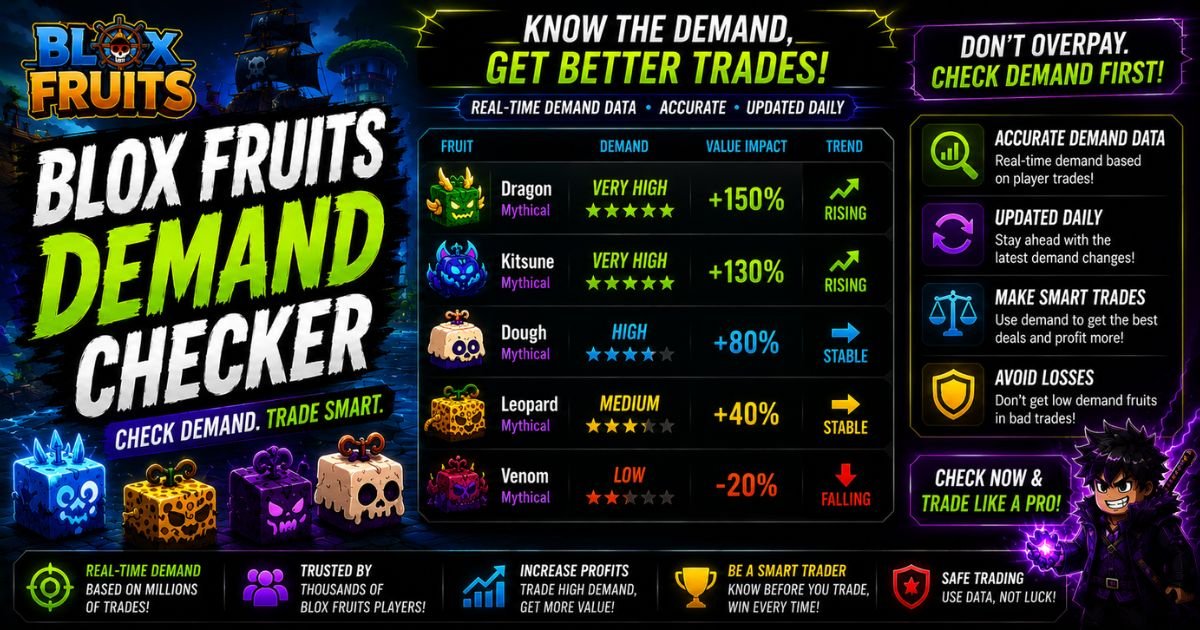
Blox Fruits Demand Checker
Check demand strength, liquidity, negotiation power and trading risk for every physical fruit. The demand rating uses a current community market snapshot and is shown beside real reference values.
Control
Portal
Buddha
Kitsune
Dragon West
Dragon East
Dough
Tiger
T-Rex
Yeti
Gas
Venom
Spirit
Magma
Shadow
Blizzard
Mammoth
Pain
Gravity
Lightning
Sound
Phoenix
Love
Spider
Quake
Diamond
Eagle
Light
Ice
Creation
Rubber
Sand
Dark
Flame
Spike
Smoke
Bomb
Spring
Blade
Spin
Rocket
Ghost
Meme
Methodology: Demand ratings and market labels are based on the 27 July 2026 TradeKitsune market snapshot and were cross-checked against current public community trackers including Gamersberg, BloxxFruits and BloxFruit.io where comparable ratings were available. Physical values are included as context. Blox Fruits has no official universal player-to-player value or demand list, so use this checker as decision support and confirm major trades with recent offers.
What Is the Blox Fruits Demand Checker?
The Blox Fruits Demand Checker is a market-analysis tool for physical fruits. Instead of showing only the estimated value, it explains how useful that fruit may be during an actual trade.
Demand represents player interest. Tradeability measures how practical the fruit is for future offers. A high-demand fruit normally attracts more attention, works better as an upgrade piece and gives its owner stronger negotiating power. A low-demand fruit may still carry value, but finding a player willing to accept the listed amount can take longer.
The tool displays several connected signals:
| Tool signal | What it tells you |
|---|---|
| Demand rating | Estimated buyer interest from 1 to 10 |
| Tradeability score | How practical the fruit may be for retrading |
| Physical value | Current primary community reference value |
| Market range | The spread between available public references |
| Source confidence | How closely different sources agree |
| Market status | Whether the fruit is stable, overpaid or underpaid |
| Trading decision | A practical recommendation based on the data |
Blox Fruits does not publish an official player-to-player demand list. Community platforms build their estimates from rarity, usefulness, offers, requests and observed trading activity. TradeKitsune, for example, says its values combine item traits with current offers, requests and external market information.
How to Use the Blox Fruits Demand Checker
Begin with the Select a Fruit dropdown. Once you choose a fruit, the main report updates with its demand rating, tradeability, value, market condition and suggested trading approach.
Use the search box when you want to find a fruit by name, rarity or type. The directory filters are helpful when you do not have one specific fruit in mind.
| Filter | Best use |
|---|---|
| Rarity | Compare fruits within the same rarity group |
| Demand Level | Find extreme, high, medium or low-demand fruits |
| Sort Directory | Rank fruits by demand, tradeability, value or confidence |
| Hot Demand | Show fruits with the strongest market interest |
| Best Liquidity | Find fruits that may be easier to retrade |
| Underrated | Find useful fruits without an overpaid label |
Click Check Demand on any fruit card to load its detailed report. The decision section then explains whether the fruit is better used as an upgrade anchor, a normal trade piece or a smaller add.
The Compare button lets you review up to three fruits together. Comparison is useful when two offers have similar values but different demand profiles. The fruit with the highest number is not automatically the best choice. Check its demand, tradeability and source confidence before deciding.
🍎 Check whether your fruit trade is fair by using our Blox Fruits Trade Calculator .
How the Demand Rating Is Calculated
The checker does not claim to show an official demand number. GameValueHub uses a structured community-demand model built from several market signals.
The main factors are:
- Buyer interest: How actively players appear to request the fruit.
- Trading activity: Whether the fruit appears regularly in public offers.
- Utility: Whether players want it for grinding, PvP, movement or future upgrades.
- Market position: Whether it is commonly accepted as a strong trade piece.
- Source agreement: Whether public community platforms show similar values and market opinions.
The demand rating is shown from 1 to 10:
| Demand score | Interpretation |
|---|---|
| 9 to 10 | Extreme or very high demand |
| 7 to 8 | High demand |
| 5 to 6 | Medium demand |
| 3 to 4 | Low demand |
| 1 to 2 | Very low demand |
The tradeability score uses a separate 100-point scale. Demand is important, but tradeability may also be reduced by weak source confidence, market volatility or an underpaid status.
The latest TradeKitsune market summary identifies Kitsune, Gas, Tiger, Buddha and Yeti among its hottest fruit trades. Its individual pages also show substantial active offer and request activity for fruits such as Kitsune and Portal.
Important Concepts Every Trader Should Understand
Demand and Value Are Different
Value estimates how much a fruit may be worth. Demand estimates how strongly other players want it.
Consider Portal and Pain. Pain may show a higher raw reference value in one community snapshot, but Portal usually has stronger practical trading demand. A trader may find Portal easier to exchange for Buddha, Spirit or another useful upgrade piece.
This does not mean demand should completely replace value. A fruit with better demand does not justify accepting a very large numerical loss. Demand should influence the decision when the two offers are already reasonably close.
Liquidity and Tradeability
Liquidity describes how easily an item can be converted into another useful trade without accepting a major discount.
A liquid fruit:
- Receives frequent offers
- Works well as an add
- Is accepted in many upgrades
- Requires less time to retrade
A low-liquidity fruit may look valuable inside a list but remain in your inventory for a long time.
Overpaid and Underpaid Status
An overpaid fruit often receives offers above its normal reference because buyer interest is strong. An underpaid fruit may regularly receive offers below the displayed value because traders are reluctant to hold it.
Overpaid does not always mean the fruit will continue rising. Market hype can reverse after an update, rework or change in player interest.
📊 Check the latest fruit prices and popularity rankings in our Blox Fruits Value List before accepting or offering a trade.
Practical Tool Testing and Realistic Trade Scenarios
The examples below use the GameValueHub market snapshot dated 27 July 2026, cross-checked on 30 July 2026. Values and demand scores are community estimates.
| Scenario | You give | You receive | Value change | Demand change | Decision |
|---|---|---|---|---|---|
| Clear win | Control, Tiger and Yeti | Kitsune | +94.5M | Stronger | Win |
| Close trade | T-Rex | Portal and Buddha | +560K | Stronger | Fair to small win |
| Risky value win | Portal | Pain | +5M | Much weaker | High-risk win |
Scenario 1: A Clear Win
You give:
- Control: 162M, demand 10
- Tiger: 146.25M, demand 9
- Yeti: 137.25M, demand 8
Your total is 445.5M.
You receive Kitsune at 540M with demand 10. The raw gain is 94.5M, approximately 21.2% above your offer. Kitsune also has very strong public trading activity. TradeKitsune currently lists its physical value at 540M and reports thousands of active offers and requests.
This trade improves both total value and concentration. You exchange three fruits for one highly demanded upgrade anchor.
Scenario 2: A Close or Fair Trade
You give T-Rex at 19.44M with demand 8.
You receive:
- Portal: 10M, demand 10
- Buddha: 10M, demand 10
The receiving total is 20M, only about 2.9% above your offer. By value, this is close to fair. By demand, the receiving side is stronger because both fruits work well as active trade pieces.
The trade is useful when you want liquidity. However, a player trying to reduce inventory slots may prefer keeping T-Rex.
Scenario 3: A Value Win With Demand Risk
You give Portal at 10M with demand 10 and receive Pain at 15M with demand 5.
The raw value gain is 5M, or 50%. A basic value checker may call this an obvious win. The Demand Checker gives a more cautious interpretation.
Portal is easier to use in upgrades, while Pain may attract slower or lower offers. The trade provides more listed value but reduces liquidity. It only makes sense when you already have a buyer for Pain or personally need it.
Common Blox Fruits Demand Mistakes
| Mistake | Why it is risky | Better approach |
|---|---|---|
| Choosing the highest value only | High value does not guarantee buyer interest | Check demand and liquidity |
| Treating demand as official | Community estimates can change | Review the data date |
| Ignoring source confidence | Public sites may disagree widely | Research uncertain fruits |
| Accepting weak bundles | Several low-demand fruits may be hard to retrade | Judge each fruit separately |
| Overpaying for hype | Demand can fall after updates | Keep overpay controlled |
| Confusing rarity with demand | Mythical does not automatically mean liquid | Check real market interest |
Another mistake is assuming every 10/10 fruit has equal trading power. Control, Portal, Buddha, Kitsune and Dragon may share a high score, but they operate at completely different values and market tiers.
Demand should always be read together with value.
Smart Strategies for Better Trades
Use high-demand fruits as upgrade anchors. These are fruits that other traders recognise quickly and are more likely to accept as the main part of an offer.
When two offers are close in value, choose the side with stronger demand. This normally gives you more flexibility in your next trade.
For downgrades, request extra value. You are exchanging one strong fruit for multiple items, taking more inventory space and accepting greater retrading work.
A practical decision process is:
- Check the total values.
- Compare the demand ratings.
- Review tradeability and source confidence.
- Look for an overpaid or underpaid label.
- Decide whether the incoming fruits support your next upgrade.
- Confirm the complete offer with the Blox Fruits Trade Calculator.
Small overpayments can be reasonable for highly liquid fruits. Large overpayments should not be justified by demand alone.
Advanced Demand Insights
Source Disagreement Creates Risk
The tool may display low source confidence when community platforms disagree on value. Dragon West is a strong example. One current reference shows 3.24B, while other public estimates can be considerably higher.
This does not prove that one source is false. It shows that different trading communities may be using different market anchors. Avoid aggressive trades when confidence is low.
Demand Can Change Faster Than Value
A value list may remain unchanged while active interest begins rising or falling. Offer and request activity can therefore provide an earlier market signal than the displayed value.
TradeKitsune reports that its market adjustment uses active offers and requests and updates its references daily.
High Concentration Increases Exposure
When most of your inventory value is stored in one fruit, a demand drop can affect a large part of your trading power.
A Dragon-heavy inventory may look impressive, but it is more exposed to changes in one market. Holding several liquid fruits can provide better flexibility, although it requires more storage and management.
Trading Safety and Tool Limitations
GameValueHub does not require your Roblox password, browser cookies, login codes or account recovery information. Never provide these details to a trader, value website or middleman.
Check the final in-game trade window before confirming. Make sure the other player has not removed a fruit, changed the offer or replaced an expected permanent item with a physical version.
The Demand Checker has important limitations:
- Demand ratings are community estimates.
- The tool cannot guarantee another player’s decision.
- Scores may change after updates or reworks.
- Source confidence does not guarantee price accuracy.
- The checker cannot analyse off-platform promises.
- It should not replace a complete value comparison.
Use the Demand Checker to understand market interest. Use the Value List for individual prices and the Trade Calculator for a complete Win, Fair or Loss analysis.
Conclusion
The Blox Fruits Demand Checker helps you judge more than the number attached to a fruit. It shows demand strength, liquidity, tradeability, market status, source confidence and practical trading risk.
Use high-demand fruits to create stronger upgrades, but do not overpay blindly. Be cautious when a trade gives you more value but much weaker demand. When source confidence is low, compare recent offers before accepting.
The safest decision combines three questions: Is the value fair? Is the incoming demand strong? Can you trade the fruit again without accepting a major discount?
FAQs
What is the Blox Fruits Demand Checker?
The Blox Fruits Demand Checker analyses how strongly players want a physical fruit. It displays a demand score, tradeability rating, market value, source confidence and trading recommendation to help users make better decisions.
Are the demand ratings official?
No. Blox Fruits does not publish an official player-to-player demand rating. GameValueHub uses researched community market signals and public trading references to create practical demand estimates.
What does 10/10 demand mean?
A 10/10 rating means the fruit currently shows extremely strong buyer interest and trading usefulness. It may work well as an upgrade anchor, although the score does not guarantee every player will accept it.
Is demand more important than value?
Neither signal should be used alone. Value explains the size of an offer, while demand explains how easily the fruit may trade again. Demand matters most when two offers have similar values.
What is tradeability?
Tradeability measures how practical a fruit is for future trades. It considers demand, liquidity, market status and confidence. A highly tradeable fruit usually attracts offers faster and works better in upgrades.
What does source confidence mean?
Source confidence shows how closely public community references agree. High confidence means the available estimates are close. Low confidence means the market is divided and requires additional checking.
What does overpaid mean?
Overpaid means traders may currently offer more than the normal reference value because demand is strong. It can create opportunities, but hype-driven overpayments can reverse after updates.
Can a lower-value fruit be better?
Yes. A slightly lower-value fruit can be more useful when it has much stronger demand and liquidity. However, better demand should not be used to justify a large value loss.
How often should demand be checked?
Check demand before every valuable trade and after major updates, reworks or market changes. High-tier fruits and newly changed fruits should be reviewed more frequently.
Does the checker include permanent fruits?
The current Demand Checker focuses primarily on physical-fruit demand because physical fruits are exchanged more frequently. Use the Blox Fruits Value List to compare separate physical and permanent values.
