
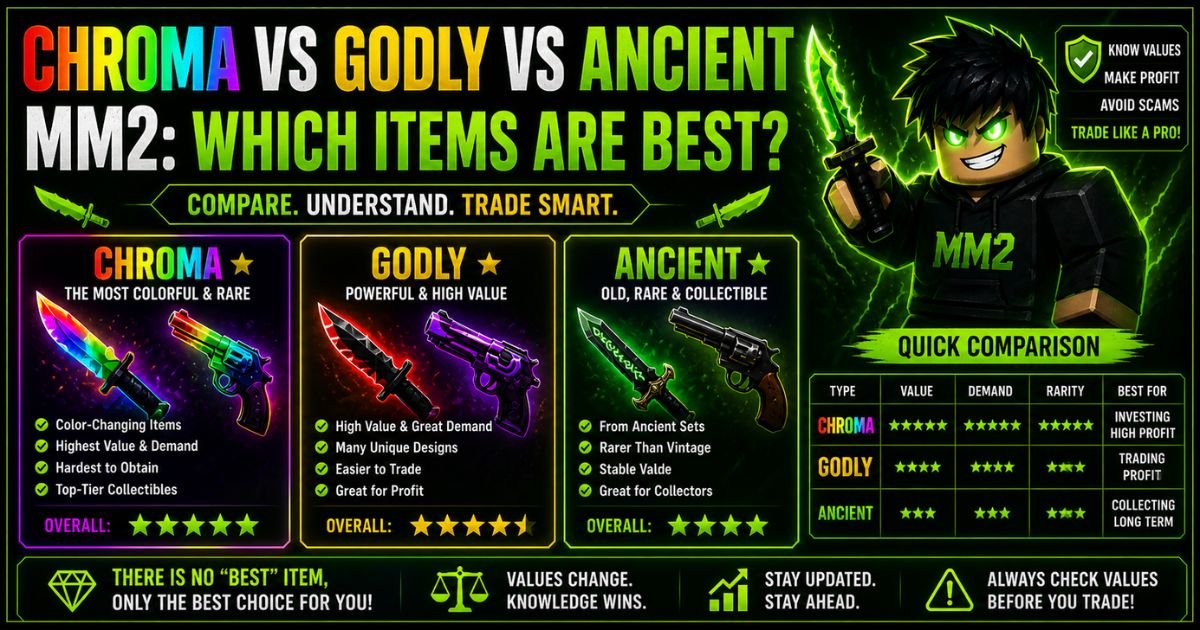
If you have spent any time trading in Murder Mystery 2, you have already heard these three words: Godly, Chroma, and Ancient. They come up in almost every serious trade conversation, every value list, and every discussion about what makes an inventory worth having. But a lot of players, especially those who are relatively new to trading, are not fully clear on what separates these three item types from each other and why that separation matters so much when it comes to actual trade value.
The Chroma vs Godly vs Ancient MM2 debate is not just about which items look coolest or which names sound the most impressive. It is about understanding a real economic hierarchy that determines how much your items are worth, how easy they are to trade, and how they will hold or grow in value over time. Getting this wrong means consistently making trades that seem fair on the surface but are actually costing you value every single time.
This guide covers all three item types in full detail, explains how they compare against each other, and gives you the practical knowledge you need to build your inventory with purpose rather than luck.
👉 For a complete trade decision, use our MM2 Trade Value Checker to check if your trade is win, fair, or lose instantly.
1. The Core Difference Between Godly, Chroma, and Ancient Items
The MM2 item system is built around rarity, and rarity in this game is determined almost entirely by how items are obtained and whether they can still be obtained today. Godly, Chroma, and Ancient items each represent a different point on that spectrum, and understanding that spectrum is the foundation of everything else covered in this article.
Godly items are the highest tier of item that can still be obtained through normal gameplay, whether through the in-game shop, crafting systems, or seasonal events. Chroma items are an elevated version of godlies that feature a distinctive color-shifting visual effect and require additional resources to create, making them rarer than standard godlies even though they are technically still obtainable. Ancient items, on the other hand, are no longer available through any current in-game method. Their supply is permanently fixed, which puts them in an entirely different category from both Godly and Chroma items when it comes to long-term value and trading prestige.
This fundamental difference in availability is what drives all the value differences between these three types. It is not about which items look the best or which ones are the most fun to use. It is about supply and demand in its most straightforward form. The fewer people who can ever obtain a certain item, the more valuable it becomes to the people who want it. That principle explains almost everything about how Godly, Chroma, and Ancient items behave in the MM2 trading economy.
2. Godly Items Explained: The Foundation of MM2 Trading
Godly items are the most recognized and most traded category of high-value items in all of MM2. For the majority of players, godlies represent the first real milestone in building a serious inventory. Getting your first godly item feels significant because it is a step above the common and uncommon items that most players start with, and it opens the door to a much wider range of trade opportunities.
The godly tier covers a broad range of items that vary considerably in their individual value, even though they share the same general label. Not all godlies are worth the same amount. Some godlies are available consistently through the shop or through crafting materials that are relatively easy to accumulate. These tend to have lower trade values because their supply is steady and players can always obtain new copies without relying on the secondhand market. Other godlies were released during specific seasonal events or limited-time windows and have since been removed from the obtainable pool. These carry a meaningful premium because once the window closed, no new copies could enter circulation.
Understanding this internal variation within the godly tier is one of the first things that separates competent traders from beginners. A player who treats all godlies as equal is going to consistently misprice their trades. A player who knows which godlies are common versus which are discontinued will always have the upper hand in negotiations involving this tier.
👉 For a Full Value list, use our MM2 Value List – Updated Godly, Ancient & Chroma Values to check if your trade is win, fair, or lose instantly.
2.1 How Godlies Function in the MM2 Economy
Godlies serve as the primary currency of MM2 trading. When experienced traders talk about how much something is worth, they almost always express it in terms of godlies, even if the actual trade involves Chromas, Ancients, or other item types. This makes the godly tier the common language of the entire trading ecosystem.
Because godlies are used as the unit of measurement for everything else, having a solid supply of them gives you flexibility in trades. You can use them to bridge value gaps, complete deals that would otherwise be impossible to balance, and build toward higher-tier items by accumulating godlies over time and trading up. This upward trading process, where you gradually exchange lower-value godlies for better ones and eventually move into Chroma or Ancient territory, is how most successful traders build their inventories.
The key to using godlies well is knowing their individual values and staying current with any changes. A godly that got re-released recently is worth less than it was before the re-release. A godly that just got discontinued is worth more. These shifts happen regularly and traders who track them gain a consistent edge over those who treat godly values as fixed.
2.2 Which Godlies Are Worth Holding?
Not every godly deserves a permanent place in your inventory. The ones worth holding are generally those with some kind of scarcity factor, whether from a limited original release, a long period of unavailability, or strong and sustained community demand. Common crafting godlies that have been available through every seasonal event tend to depreciate over time as more copies enter circulation and demand stays flat.
Seasonal event godlies that have only appeared once or twice and have not returned are worth paying attention to. Every season that passes without a re-release increases the probability that the item is truly discontinued, which pushes its value upward. Watching which items keep coming back versus which ones have quietly disappeared from new event shops is a useful skill that pays off over months of trading.
3. Chroma Items Explained: The Visual Upgrade with Real Value
Chroma items are one of the most distinctive visual categories in all of MM2. When you inspect a Chroma weapon, its texture shifts through a full spectrum of colors in a smooth, flowing gradient pattern. That visual effect is entirely cosmetic in terms of gameplay, but in the context of trading, it represents a meaningful upgrade in both rarity and perceived prestige over the standard godly version of the same item.
The Chroma designation is not applied to all godlies. Only specific weapons have Chroma versions, and obtaining them requires crafting the item using the base godly plus a set of Chroma Shards or similar event materials. This crafting requirement serves as a natural gate on supply. Players who want a Chroma version have to either earn the materials through extended gameplay and event participation or trade for them directly, and that friction keeps Chroma item quantities lower than their standard godly counterparts.
From a trading perspective, Chroma items occupy a position that is clearly above standard godlies but below Ancients in the overall rarity hierarchy. They are still technically obtainable, which distinguishes them from Ancients, but the added visual appeal and the cost of the crafting process give them a consistent premium in the market. That premium varies by item, but it is always present.
ALSO YOU CAN CHECK: MM2 WFL Calculator – Win, Fair Lose Trade Checker
3.1 Why the Chroma Visual Effect Drives Demand
It might seem like a visual effect should not matter much in a trading economy, but in MM2, it absolutely does. The community places real value on how an item looks in your inventory and when holding it during a game. Chroma items stand out immediately. They signal that the holder has either put significant time into the crafting system or has access to enough trade value to acquire them on the market. That signal has social weight in a game where inventory prestige is part of the appeal.
Players who are building display inventories rather than purely trading for profit often specifically target Chroma versions of their favorite weapons. This collector demand adds a layer to Chroma pricing that goes beyond pure supply and demand economics. Even when a Chroma item’s market supply is relatively stable, sustained collector demand keeps its value elevated above what simple availability calculations would suggest.
3.2 Chroma Crafting vs Buying Through Trading
Players who want a specific Chroma item have two main paths: craft it themselves or acquire it through trading. The decision between these two approaches involves calculating the current value of the required crafting materials against the current trade value of the finished Chroma item. If the materials cost less to acquire than the finished Chroma is worth, crafting makes economic sense. If the materials are expensive and the finished product is not trading for much of a premium, buying directly through the trade market may be the better move.
This calculation changes regularly based on event schedules and how easy it is to accumulate crafting materials in any given period. Active players who participate heavily in events can accumulate materials faster and at lower effective cost, making crafting more attractive for them. Players who are less active or who join the game after an event has ended will generally find it more efficient to trade directly for the Chroma items they want.
4. Ancient Items Explained: The Pinnacle of MM2 Rarity
Ancient items represent the top tier of what most MM2 traders will ever realistically encounter in a trade. They are no longer obtainable through any current in-game method, which means the total number of each Ancient item in the game is fixed and can only decrease over time as accounts are abandoned, banned, or items are lost through scams. This permanent scarcity is what gives Ancients their extraordinary value and their special status within the trading community.
The items that carry the Ancient classification were typically released during significant early periods of MM2’s history or during major milestone events that have since concluded. Many of them were obtained by players who did not fully understand what they had at the time, which means a meaningful portion of the original supply was traded away below value in the early days of the game. That historical underprice means the current supply of well-preserved Ancients held by informed traders is actually smaller than the total number ever created.
Trading Ancients is a different experience from trading godlies or Chromas. Because Ancients are so valuable, the stakes in any Ancient trade are high. A single misstep, whether from misidentifying an item, misreading the market, or falling for a scam, can represent the loss of something equivalent to dozens of godlies. This is why Ancient trades require more research, more verification, and more patience than any other type of MM2 transaction.
4.1 How Ancient Items Are Valued Relative to Godlies
The value of any given Ancient item is typically expressed as a multiple of godlies, and that multiple can be substantial. Depending on the specific Ancient, its history, and how actively it trades in the current market, it might be worth anywhere from a significant stack of standard godlies to an amount that would take most players months of active trading to accumulate.
This high value makes Ancients the target of some of the most sophisticated scam attempts in the MM2 ecosystem. Scammers invest more effort in deception when the potential reward is greater, which means Ancient trades require every protection a careful trader can apply. Always verify item names precisely, never rush a decision, and cross-reference values across multiple sources before agreeing to any deal involving an Ancient.
4.2 The Long-Term Value Case for Ancients
From a purely economic standpoint, Ancients make a compelling case for long-term holding. Their supply cannot increase. The game continues to grow, bringing in new players who will eventually want to own or trade for the rarest items in the ecosystem. As demand grows and supply stays fixed or decreases, basic economics predicts that prices will move upward over time.
This does not mean every Ancient will increase in value indefinitely or that there are no risks to holding them. Community interest in specific items can shift. The overall health of the MM2 trading ecosystem can change. But as a category, Ancients have historically held their value well and trended upward over time, which makes them attractive to traders who think beyond the immediate next trade and consider the longer arc of their inventory-building strategy.
ALSO READ: MM2 Values vs Supreme Values: Which MM2 Value List Is Best?
5. Direct Comparison: Chroma vs Godly vs Ancient MM2
5.1 Side-by-Side Overview
| Feature | Godly | Chroma | Ancient |
|---|---|---|---|
| Still Obtainable | Yes (most) | Yes (crafting) | No |
| Visual Effect | Standard | Color-shifting gradient | Standard or special |
| Trade Frequency | Very High | High | Occasional |
| Value Range | Low to High | Moderate to Very High | Very High to Extreme |
| Supply | Variable, replenishable | Limited by crafting | Fixed permanently |
| Beginner Accessibility | High | Moderate | Low |
| Long-term Value Trend | Variable | Generally stable | Upward trend |
| Scam Risk in Trades | Moderate | Moderate to High | Very High |
5.2 Value Hierarchy in Practice
The practical value hierarchy from lowest to highest goes: common godlies at the base, limited or discontinued godlies above them, Chroma items above discontinued godlies in most cases, and Ancient items at the top. However, this is a general framework and not a universal rule. Some specific godlies that were released in very limited quantities hold more value than certain Chromas. Some Chromas that are in high demand trade closer to lower-end Ancients in terms of their market price.
The point is not to memorize a fixed ranking but to understand the principles behind the hierarchy. Scarcity drives value. Demand sustains it. Items that combine both permanent scarcity with sustained demand sit at the top of the market, and that combination is exactly what Ancients represent at their best.
6. Real Scenarios: How These Item Types Play Out in Actual Trades
Scenario 1: The Uninformed Swap A new player has a discontinued seasonal godly that stopped being available two events ago. A more experienced trader offers them a Chroma item they do not recognize in exchange. The new player, not knowing the value difference, agrees because the Chroma looks impressive and they have heard Chromas are good. In reality, their discontinued godly was worth more than the specific Chroma being offered. The experienced trader walked away with more value simply because they understood the hierarchy and the other player did not.
Scenario 2: The Crafting Decision A player has accumulated enough Chroma Shards during the current event to craft a specific Chroma godly. They check both MM2Values and Supreme Values and find that the Chroma version is trading at a price noticeably above the combined value of the base godly plus the shards. They craft the item and immediately have a higher-value asset than the materials they started with. This is exactly the calculation that informed crafters make during every event cycle.
Scenario 3: The Ancient Offer A trader receives an offer involving an Ancient knife they own. The person offering is willing to give multiple high-end Chromas plus several strong godlies in exchange. The Ancient holder does their research, checks current values on both major lists, and consults a trusted community source before responding. They determine the offer is reasonable but slightly below the current market value. They counter with a small adjustment, the other party accepts, and both traders leave satisfied because the Ancient holder knew exactly what they had.
ALSO CHECK: MM2 Trade Suggestion Tool – Smart Trade Decision System
7. Common Mistakes Players Make When Comparing These Item Types
- Assuming all godlies are worth the same. This is the single most common error in MM2 trading. The godly label covers items that range enormously in value. Never accept or make an offer without checking the specific godly involved.
- Undervaluing discontinued godlies relative to Chromas. Some players automatically assume any Chroma beats any godly. A rare discontinued godly from several years ago may actually trade above a common or lower-demand Chroma.
- Overestimating Chroma value based on appearance alone. Chromas are visually impressive, but their value depends on demand and supply for that specific item, not just the presence of the color effect. A Chroma for an item nobody wants much is not worth what a Chroma for a highly demanded item is worth.
- Not verifying Ancient item identity before trading. Because Ancients are valuable, scammers sometimes use items with similar visual appearances or names to trick traders. Always read the exact item name in the trade window, never rely on visual appearance alone.
- Rushing into Ancient trades due to excitement. The moment someone offers you an Ancient, the temptation to confirm quickly is real. Scammers know this and deliberately create urgency. Slow down. The trade will still be there after you do your research.
8. Smart Tips for Building an Inventory Across All Three Tiers
- Start with godlies and learn their individual values before moving up. Trying to jump straight into Chroma or Ancient trading without a solid foundation in godly valuation is a common mistake that usually ends in lost value. Spend time understanding which godlies are common, which are scarce, and how their values move before trading at higher tiers.
- Track event cycles to identify crafting opportunities. Chroma items become significantly more accessible during events that provide crafting materials. Planning your trading activity around these windows lets you enter the Chroma tier at lower cost than buying directly from the trade market at other times.
- Use both value lists when evaluating Chroma and Ancient trades. The stakes are higher at these tiers, which makes the extra step of cross-referencing MM2Values and Supreme Values worth the time investment. A five-minute research step can prevent a trade mistake that costs the equivalent of many hours of trading work.
- Consider long-term holding for Ancients. Unlike most godlies, which can be replaced through new crafting cycles, Ancients will never be available again. Holding them during periods of lower demand and trading them during periods of high demand is a strategy that rewards patience.
- Learn to recognize each item’s name, not just its appearance. This applies especially to Chromas and Ancients, where visual similarities between different items can be exploited by scammers. Building name recognition is a protection skill, not just a knowledge exercise.
- Build toward tier upgrades systematically. Rather than making random trades, plan a clear path from where your inventory is now to where you want it to be. Identify the specific Chroma or Ancient you want to work toward and make trades that consistently move you in that direction rather than sideways.
9. Advanced Insights: The Investment Mindset for Each Tier
The way you should think about Godly, Chroma, and Ancient items changes significantly depending on whether you are approaching MM2 trading as a casual activity or as a systematic effort to build inventory value over time. Players who adopt what might be called an investment mindset consistently outperform those who trade reactively.
For godlies, the investment mindset means focusing on items that have a clear path to appreciation. Freshly discontinued godlies are interesting because they are transitioning from an obtainable item to a scarce one, and the market often underprices them during that transition window before fully catching up to the new reality. Entering a position in a recently discontinued godly before the community widely recognizes its increased scarcity can deliver solid returns over a period of months.
For Chroma items, the investment consideration is different. Since supply can technically still be added through crafting, Chromas are less about scarcity and more about sustained demand. The Chroma items worth holding for value rather than just personal use are those attached to weapons the community consistently loves and trades frequently. High-demand Chromas with active buyer interest are safer long-term holds than Chromas for items that have fallen out of community favor.
For Ancients, the investment case is the strongest but also requires the most capital to enter and the most patience to execute. Because you need significant existing value to acquire an Ancient in the first place, this tier is not accessible to early-stage traders. But for those who have built enough inventory through systematic godly and Chroma trading to make the jump, Ancients offer the most predictable long-term value trajectory of any item type in the game. Fixed supply, growing player base, and enduring prestige combine to make them the closest thing to a reliable store of value that MM2 trading has to offer.
Conclusion
Understanding the difference between Chroma, Godly, and Ancient items in MM2 is not just a matter of knowing which tier sounds more impressive. It is about developing a real understanding of how rarity, availability, demand, and history combine to determine what items are actually worth and how they are likely to behave over time. Each tier has its own role in the trading ecosystem, its own strengths, and its own risks.
Godlies are the backbone of everyday trading and the foundation every serious trader needs to understand deeply before moving higher. Chromas offer a meaningful upgrade in visual appeal and value for players willing to invest the crafting resources or trade capital to acquire them. Ancients represent the pinnacle of what most traders will encounter, combining permanent scarcity with enduring demand in a way that makes them the most reliably valuable items in the entire game.
The best traders are the ones who understand all three tiers clearly, know how to move between them strategically, and never let excitement or impatience override the research habits that protect their inventory. Use this guide as your reference and build your MM2 inventory with the same deliberate thinking that separates profitable traders from players who always seem to wonder where their value went.
FAQs
Is a Chroma item always worth more than a standard Godly?
In almost all cases, yes. Chroma items require additional crafting resources on top of the base godly, which naturally limits their supply and adds value. However, a rare discontinued godly can sometimes trade above a less popular or lower-demand Chroma. The specific items involved always matter more than the general tier label, which is why checking current values before any trade is essential.
Can you still get Ancient items in MM2?
No, Ancient items are no longer obtainable through any current gameplay method. They were released during specific historical windows and have since been permanently removed from the game’s drop and shop systems. The only way to acquire an Ancient today is to trade with another player who already owns one, which is part of what makes them so valuable.
How many Godlies is a Chroma item worth?
The answer varies significantly depending on which specific Chroma item is being discussed and how current the market data is. There is no single conversion rate that applies to all Chromas. Some are worth a handful of standard godlies above the base version, while highly sought-after Chromas can be worth many godlies more. Always check both MM2Values and Supreme Values for the specific item before negotiating.
Are Ancient items a good investment for long-term trading?
Generally yes, because their supply is permanently fixed and cannot increase no matter how many new players join the game. As the overall MM2 player base grows over time, demand for the rarest items tends to grow with it while supply stays constant or decreases. That dynamic has historically supported upward value trends for Ancients as a category, though individual items can vary based on community interest.
What is the best item type to focus on as a beginner trader?
Godlies are the right starting point for beginner traders because they are the most widely understood, the most frequently traded, and the easiest to research using community value lists. Building a deep knowledge of godly values and which ones are scarce versus common gives you the foundation you need before moving into Chroma or Ancient trading, where the stakes are higher and mistakes are more costly.
