
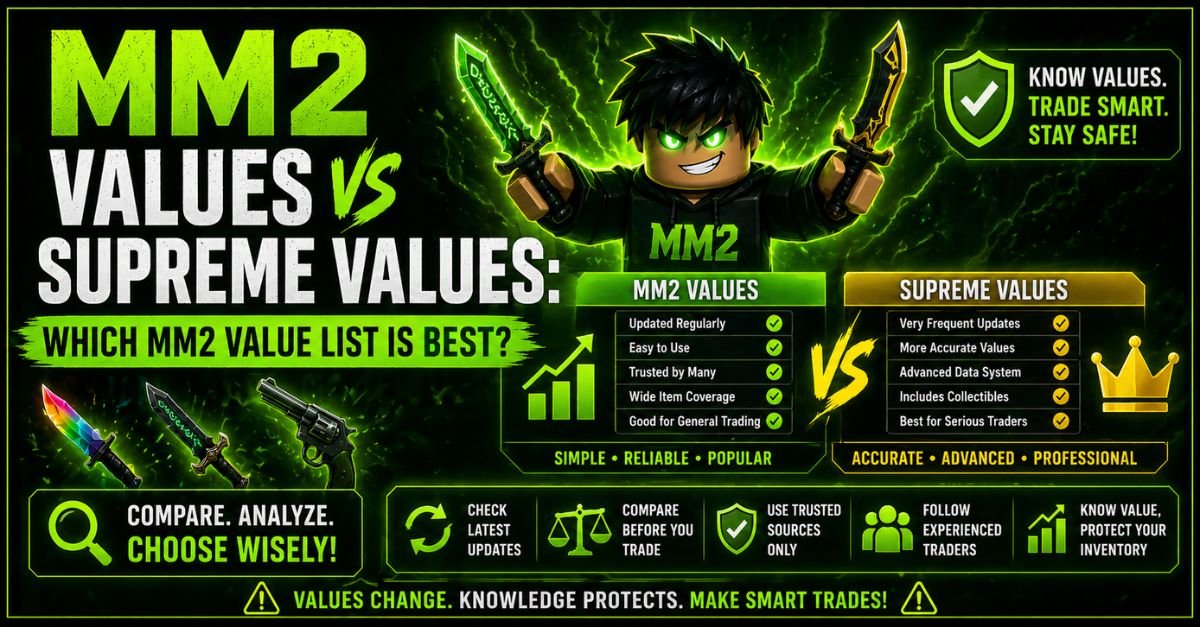
One of the first questions every MM2 trader runs into is which value list to actually trust. The two names that come up most often are MM2Values and Supreme Values. Both are popular community-run references for comparing MM2 items, but neither list should be treated as a guaranteed final trade price. Actual offers can change depending on demand, availability, recent updates, and the quality of the items included in a trade. But if you have spent any time trading in Murder Mystery 2, you already know that these two lists do not always agree with each other, and that difference matters when real trades are on the line.
The MM2Values vs Supreme Values debate has been going on for years within the trading community. Some traders swear by one and refuse to acknowledge the other. Others use both together and try to find a middle ground. Newer players often end up confused, accepting bad trades because they did not know which source to reference or because a scammer exploited the gap between the two lists to their advantage.
This article gives you a thorough, honest, and detailed comparison of both value lists. You will understand how each one works, where they differ, what their strengths and weaknesses are, and most importantly, how to use both of them intelligently to protect yourself and make better trades.
👉 For a complete trade decision, use our MM2 Trade Value Checker to check if your trade is win, fair, or lose instantly.
1. Why Value Lists Matter in MM2 Trading
Value lists are the backbone of the entire MM2 trading experience. Without them, there would be no common ground for two players to stand on when deciding whether a trade is fair. Every time you look at a trade offer and try to figure out if you are getting a good deal or being lowballed, you are relying on the work that goes into maintaining these lists. Understanding why they exist, how they function, and why they sometimes fail gives you a massive advantage over traders who just accept the first number they see without questioning where it came from or how current it actually is.
Before comparing the two lists directly, it is worth understanding why value lists exist in the first place and why they carry so much weight in the MM2 trading community. MM2 is a player-driven economy. Unlike games with fixed auction houses or official price guides, MM2 has no in-game pricing system. Items do not have official values set by the developers. Every trade is a negotiation between two players, and the outcome depends entirely on what both parties believe an item is worth.
Without a shared reference point, trading would be chaotic. Experienced players would consistently exploit newer ones who have no way of knowing whether an offer is fair. Scammers would have an even easier time manipulating deals. Value lists solve this by giving the community a common language and a shared set of numbers that most players at least loosely agree to reference.
The problem is that value lists are created and maintained by community members, not by the developers. This means they reflect the opinions and observations of whoever runs them, and those opinions can differ. When two major lists assign different numbers to the same item, traders end up arguing about which one is correct, and the disagreement can stall or ruin deals that should have gone smoothly.
Understanding this context makes the MM2Values vs Supreme Values comparison much more meaningful. You are not just choosing between two websites. You are choosing which community standard to anchor your trading decisions to, and that choice has real consequences for every deal you make.
👉 For a complete Value list, use our MM2 Value List to check if your trade is win, fair, or lose instantly.
2. What Is MM2Values?
MM2Values is one of the longest-running MM2 value references and says it has been active since 2017. Many players use it to compare item values, demand, rarity, and stability. However, its listed numbers should still be treated as trading references rather than automatic final prices for every offer. Understanding what MM2Values actually is, how it got its reputation, and how it decides what your items are worth is essential before you can properly judge whether it deserves that trust or whether you should be supplementing it with other sources.
2.1 Overview and Origins
MM2Values is one of the longest-standing and most widely referenced value lists in the MM2 trading community. It has been around for a considerable amount of time and built its reputation by attempting to track actual trade data and community consensus rather than relying solely on individual opinion. The platform aims to provide a comprehensive catalog of item values that reflects what items are genuinely trading for across the community at any given time.
The site covers a broad range of item types, including godlies, Chromas, Ancients, seasonals, and event items. Each item is assigned a numerical value that can be used to compare items against each other and determine whether a trade is fair, overpaying, or underpaying. The values are periodically updated as market conditions change, though the frequency and responsiveness of those updates has been a topic of debate within the community.
MM2Values has historically been considered a more conservative list, meaning it tends to assign values that reflect stable, broadly agreed-upon prices rather than reacting immediately to short-term fluctuations in demand. This approach has both advantages and disadvantages, which are covered in detail later in this article.
2.2 How MM2Values Determines Item Prices
MM2Values bases its numbers on a combination of factors, including observed trade activity, community input, and historical pricing trends. The team behind the list monitors what items are actually trading for across different trading servers, Discord communities, and direct player-to-player deals. When enough data points suggest a consistent price range for an item, that range gets reflected in the list.
One important thing to understand is that MM2Values, like any community list, involves human judgment. The people maintaining it make decisions about how much weight to give different data sources, when to update a value, and how to handle items that are trading at a wide range of prices, depending on who the buyer and seller are. These judgment calls introduce subjectivity even when the goal is objectivity.
Players who prefer MM2Values often cite its stability and its broad community recognition as key reasons. Because so many traders know and reference MM2Values, using it as your benchmark means you are speaking the same language as a large portion of the trading population. Negotiations are easier when both parties are working from the same starting point.
ALSO READ: MM2 Item Types Guide: Chroma, Ancient, Vintage & Other Items
3. What Is Supreme Values?
Supreme Values entered the MM2 trading scene as a direct response to what a growing portion of the community felt was a gap in MM2Values, specifically around update speed and market responsiveness. It built its identity around being faster, more engaged with the active trading community, and more willing to adjust numbers quickly when the market clearly moved in a new direction. While it is newer in terms of community history, it has developed a very loyal following, particularly among traders who are active in high-volume trading circles and need a reference they can trust to be current rather than comfortable. To properly evaluate Supreme Values, you need to look at both where it excels and where its faster pace can occasionally work against a trader’s interests.
3.1 Overview and Origins
Supreme Values emerged as an alternative to MM2Values and quickly developed its own dedicated following within the trading community. It positions itself as a more actively maintained and responsive list that aims to reflect real-time market conditions more accurately than its competition. The platform has invested in building a community around itself, including Discord servers where traders can discuss values, report trades, and engage with the people running the list.
Supreme Values covers the same general range of MM2 items, but often assigns different numbers to the same items compared to MM2Values. In some cases, the differences are minor. In others, they are significant enough to completely change whether a trade looks fair or unfair, depending on which list you are using. This inconsistency between the two lists is the central tension in the MM2Values vs Supreme Values debate.
The list has grown in popularity, particularly among traders who felt that MM2Values was too slow to update or too conservative in its pricing. Supreme Values attracted players who wanted numbers that better reflected what was actually happening in the market at any given moment, especially during periods when certain items were spiking in demand or dropping in value due to new releases.
3.2 How Supreme Values Determine Item Prices
Supreme Values places a strong emphasis on community participation in its valuation process. The platform actively solicits trade reports and market observations from its user base, and this crowdsourced data informs how values are set and adjusted. The team behind Supreme Values also monitors active trading channels and Discord servers to track where prices are actually landing in completed deals.
This more dynamic approach means Supreme Values can react faster to market shifts. When a new event releases items that affect the value of existing ones, Supreme Values tends to update its numbers more quickly. This responsiveness is genuinely useful for active traders who are trying to stay current with a fast-moving market.
The tradeoff is that faster updates can sometimes mean values that are less stable and harder to predict. A price that just updated yesterday may look very different from a price that has been stable for months, and that instability can create confusion in trade negotiations where both parties expect consistent reference points.
ALSO CHECK THIS: MM2 Inventory Value Calculator – Check Your Total MM2 Worth
4. Head-to-Head Comparison: MM2Values vs Supreme Values
Putting both lists side by side is where the real picture starts to emerge. It is one thing to read about each list individually and understand its philosophy and update approach. It is another to see exactly how they compare across the features that actually matter during a trade. This section breaks down the key differences between MM2Values and Supreme Values in a clear, direct way so that you can see at a glance where one outperforms the other, where they are roughly equal, and where the choice between them genuinely depends on your specific trading style and how frequently you engage with the MM2 market.
4.1 Key Differences at a Glance
| Feature | MM2Values | Supreme Values |
|---|---|---|
| Update Frequency | Moderate, more stable | Frequent, more reactive |
| Community Size | Large, long-established | Growing, active Discord |
| Value Approach | Conservative, consensus-based | Dynamic, market-reactive |
| Coverage | Broad item catalog | Broad item catalog |
| Beginner Friendliness | High, widely understood | Moderate, requires familiarity |
| Accuracy During Events | Can lag behind | Usually more current |
| Stability Between Updates | High | Moderate |
| Trader Preference | Traditional traders | Active and competitive traders |
4.2 Where the Two Lists Agree
It is worth noting that MM2Values and Supreme Values are not completely at odds. For many common items, particularly standard godlies that have been in the game for a long time and trade at high volume, the two lists tend to be reasonably close to each other. High-volume items generate a lot of trade data, and that data points both lists toward similar conclusions even if the exact numbers do not match perfectly.
When both lists assign similar values to an item, that agreement actually increases your confidence in the price. If MM2Values says an item is worth 50 and Supreme Values says it is worth 48, those numbers are close enough that you have a reliable reference range. Trading in that range means both parties are likely to accept the deal as fair, regardless of which list they prefer.
4.3 Where the Two Lists Disagree
The real tension between the two lists appears with items that are subject to rapid demand changes, seasonal items that come in and out of availability, and rarer items that trade less frequently. For these items, the two lists can assign very different values, and that gap becomes a source of conflict in actual trade negotiations.
A common example is a recently discontinued seasonal godly. When an item stops being available in the shop or through crafting, demand often spikes as players realize they can no longer obtain it directly. Supreme Values, with its faster update cycle, may raise the item’s value quickly to reflect this new reality. MM2Values, being more conservative, may wait until a clearer consensus emerges across many trades before raising the number. During that window, the two lists show significantly different prices for the same item.
Scammers are aware of this gap and deliberately exploit it. They will reference whichever list shows the lower value when they want to lowball you, and reference the higher value when they want to convince you to accept less in a trade. Being aware that both lists exist and knowing where they differ is an essential defensive skill.
OUR NEW TOOL: MM2 Trade Profit Calculator – Check Trade & value Gain
5. Real Scenarios: How the List Difference Affects Your Trades
Reading about value list differences in the abstract only goes so far. The real impact of the MM2Values vs Supreme Values gap becomes obvious when you see it play out in actual trade situations. These scenarios are based on patterns that happen regularly in the MM2 trading community, and chances are you will recognize situations like these from your own experience or from watching other traders in servers and Discord channels. Pay attention to how the list difference acts as a hidden variable in each scenario, because once you can see it clearly here, you will start noticing it in real trades too.
Scenario 1: The Seasonal Spike A player owns a seasonal godly that just got discontinued. Supreme Values already raised the item’s value by 20 points to reflect new demand. MM2Values has not updated yet and still shows the old price. A trader approaches and insists on using MM2Values to value the item, offering what looks like a fair deal by that standard. The seller, not knowing Supreme Values has already adjusted, accepts a trade that is actually significantly below current market value.
Scenario 2: The Opposing Reference Problem Two traders are negotiating a deal involving multiple items. One trader exclusively uses MM2Values. The other exclusively uses Supreme Values. For three of the items involved, the lists are close enough that agreement is easy. But one high-value item shows a 30-point difference between the two lists. Neither trader is willing to accept the other’s reference, and a deal that should have happened easily falls apart because there is no agreed standard.
Scenario 3: The Informed Trader A trader who uses both lists approaches a negotiation knowing that the item they want to acquire is valued at 60 on MM2Values and 75 on Supreme Values. Rather than committing to either number rigidly, they offer 65, acknowledging the gap and positioning themselves in the middle. The other party sees this as reasonable and the trade goes through smoothly. Both traders leave satisfied because the negotiation accounted for the real state of the market.
6. Common Mistakes Traders Make Regarding Value Lists
Even traders who know both lists exist and understand the basics of their differences still fall into predictable patterns that cost them value over time. These mistakes are not unique to beginners. Experienced traders make them too, especially when they get comfortable and stop double-checking their assumptions. The following points cover the most frequent errors players make when using value lists as part of their trading process. Going through them honestly and thinking about whether any of them apply to your current habits is a valuable exercise that most traders skip but should not.
- Treating one list as absolute truth. Neither MM2Values nor Supreme Values is perfectly accurate at all times. Both are community tools with limitations. Treating either one as an unquestionable authority leads to rigid positions in negotiations that often break down.
- Not knowing which list the other trader uses. Before entering a negotiation, it helps to ask or observe which value system the other person is working from. Trying to negotiate without knowing this is like having a conversation where both people are speaking different languages.
- Ignoring both lists and relying on memory. Some experienced traders stop consulting value lists because they feel confident in their knowledge. But values shift regularly, and memory-based pricing leads to errors, especially for items that trade infrequently.
- Letting scammers choose the list for you. If someone in a trade is pushing hard for you to use a specific list, ask yourself why. Legitimate traders do not usually have a strong preference for one list over another unless that preference benefits their side of the deal.
- Using outdated cached versions of either list. Value lists update regularly. If you are working from a version you loaded a week ago without refreshing, you may be using prices that no longer reflect the current market, especially around event periods.
7. Smart Tips for Using Both Value Lists Together
Knowing that both MM2Values and Supreme Values exist is only the beginning. The real skill is in knowing how to use them together in a way that gives you better information than either list would provide on its own. Traders who master this approach find themselves making more confident offers, winning more negotiations, and getting fewer bad deals past them. The tips below are practical and specific, not vague advice like “do your research.” Each one reflects a habit that improves with practice and compounds over time as you build experience across more trades.
- Cross-reference both lists for every significant trade. Before finalizing any deal involving rare or high-value items, check what both MM2Values and Supreme Values say. If they agree, you have a reliable price. If they disagree, you know to investigate further before committing.
- Use the gap as a negotiation tool. When MM2Values and Supreme Values show different prices, the honest middle ground between them is often a fair starting point for negotiation. Proposing a value that acknowledges both lists shows the other trader you are informed and acting in good faith.
- Pay extra attention to list updates during events. Event periods cause the most volatility in MM2 item values. During these times, check for updates to both lists more frequently than usual, because a price from two days ago may already be outdated.
- Save both list URLs and bookmark them. Having quick access to both references means you are never caught without a comparison tool when a trade opportunity arises unexpectedly.
- Participate in trading community discussions. Beyond the lists themselves, active MM2 trading Discord servers provide real-time trade reports and value discussions that can fill the gaps when the two lists disagree. Combining list data with community conversation gives you the most complete picture.
- Note when both lists agree versus when they diverge. Over time, you will start to see patterns in which types of items the two lists consistently differ on. That pattern knowledge helps you anticipate where disagreements will come up before they slow down your trades.
ALSO THIS TOOL: MM2 WFL Calculator – Win, Fair Lose Trade Checker
8. Advanced Insights: Understanding Why the Lists Differ
Most traders interact with value lists at the surface level. They check a number, compare it to an offer, and make a decision. That approach works for basic trades but leaves you unprepared for the more complicated situations where the two lists tell different stories and you need to understand why. The reason MM2Values and Supreme Values show different numbers is not random or accidental. It comes from a deliberate difference in how each platform thinks about its own role in the MM2 economy, and understanding that difference will change the way you approach every future trade negotiation that involves a disagreement over price.
At a deeper level, the reason MM2Values and Supreme Values often show different numbers for the same items comes down to a fundamental difference in philosophy about what a value list is supposed to do. MM2Values leans toward representing a stable, community-wide consensus that changes gradually as clear evidence accumulates. Supreme Values leans toward representing the current active market as closely as possible, even if that means more frequent and sometimes larger shifts in listed prices.
Neither philosophy is wrong. They serve different needs. A trader who makes five or ten trades a week and is deeply embedded in the active market benefits from the responsiveness of Supreme Values. A trader who makes fewer but larger trades and values stability in their reference point may prefer the consistency of MM2Values.
The community itself reflects this divide. Long-time traders who established their knowledge base using MM2Values often remain loyal to it because their intuitions about item values are calibrated to its numbers. Newer traders who learned to trade using Supreme Values as their primary reference have a different internal model of what things are worth. When these two groups trade with each other, the list difference is often the hidden source of friction in negotiations that seem to be going badly for no obvious reason.
Understanding this deeper dynamic turns you from a passive user of value lists into someone who can navigate disagreements intelligently. You can recognize when a dispute is really about list philosophy rather than the actual market, propose compromises that both parties can accept, and move trades forward instead of letting them collapse over a numbers disagreement that both sides are approaching in good faith.
Conclusion
Every article about MM2 trading eventually has to answer the same question: which list should you actually use? The honest answer is that framing it as a choice between one or the other is the wrong way to think about it. Both MM2Values and Supreme Values are valuable tools when used correctly, and the traders who get the most out of them are the ones who understand what each list is good at rather than dismissing one in favor of the other. The goal is not loyalty to a list. The goal is accurate information that helps you make better decisions.
The MM2Values vs Supreme Values debate does not have a single correct answer because both lists have genuine strengths and real limitations. MM2Values offers stability, wide recognition, and a conservative approach that works well for standard high-volume items. Supreme Values offers responsiveness, active community engagement, and pricing that tends to reflect current market conditions more quickly during volatile periods.
The smartest approach is not to pick one and ignore the other. Use both. Cross-reference them before significant trades. Understand where they typically agree and where they diverge. Use that knowledge to negotiate from an informed position rather than a defensive one.
Most importantly, understand that value lists are tools, not rules. They exist to help you make better trading decisions, not to dictate every number in every deal. The traders who consistently come out ahead in MM2 are the ones who understand the market deeply enough to know when a value list is right, when it is lagging, and how to bridge the gap between different community standards in a way that gets deals done fairly.
Frequently Asked Questions
The questions below are the ones that come up most often when traders are trying to figure out how to navigate the MM2Values vs Supreme Values split. Whether you are brand new to trading or have been at it for a while, these answers cover the practical realities of using both lists in everyday trading situations. Read through all of them even if a specific question does not seem immediately relevant to you, because the context in each answer often connects to situations you will encounter sooner or later in your trading journey.
Which value list is more accurate, MM2Values or Supreme Values?
Neither list is universally more accurate than the other. MM2Values tends to be more stable and is widely recognized across the community, while Supreme Values is often faster to reflect recent market changes. The most reliable approach is to use both lists together and compare their numbers before making any significant trade decision.
Why do MM2Values and Supreme Values show different prices for the same items?
The two lists use different approaches to setting and updating values. MM2Values prioritizes community-wide consensus and updates conservatively, while Supreme Values updates more frequently based on active market data. This philosophical difference means they often show different numbers, especially for items that have recently changed in availability or demand.
Can a scammer use the difference between the two lists against me?
Yes, and this is a common tactic. Scammers will reference whichever list makes their offer appear fairer, either citing the lower value when trying to lowball you or pointing to the higher value when trying to convince you to accept less in return. Always check both lists yourself rather than relying on the list a potential trading partner tells you to use.
Should beginners use MM2Values or Supreme Values?
Beginners often find MM2Values more approachable because of its long history and wide community recognition. Most trading tutorials and guides reference MM2Values as a baseline. However, learning to use both lists from early on is strongly recommended, since it builds a more complete understanding of how MM2 item prices actually work across the community.
How often should I check value lists before trading?
You should check both lists before any trade involving godlies, Chromas, Ancients, or other high-value items. During active event periods, checking more frequently is worthwhile because values can shift quickly. For lower-value common items, regular weekly checks are usually sufficient to stay reasonably informed without spending excessive time on list research.
