
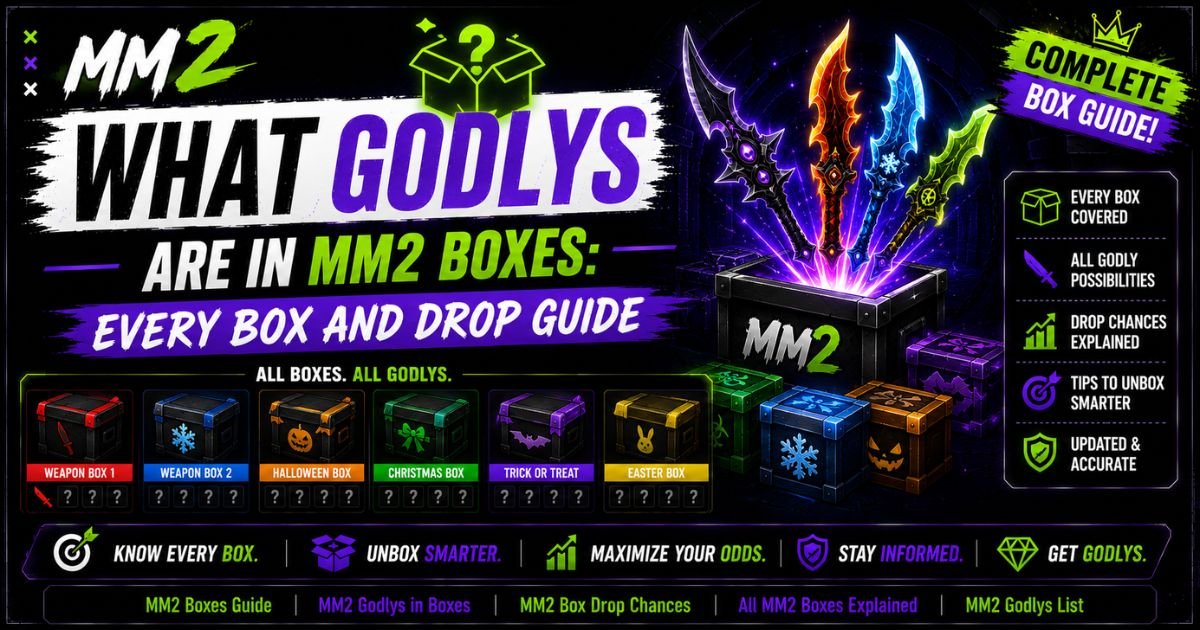
If you have ever spent seers on an MM2 box and walked away with nothing worth keeping, you already know how important it is to understand exactly what godlys are in MM2 boxes before you open them. Not every box gives you the same odds, and not every godly in those boxes holds the same trade value. Some boxes are packed with high-demand godlys that traders actively want. Others are mostly filler, with one rare godly buried under piles of lower-tier items that nobody wants to take in a deal.
This guide covers every major box available in Murder Mystery 2, breaks down which godlys drop from each one, explains how rarity and supply affect what those godlys are worth after you unbox them, and helps you decide whether spending on boxes is actually worth it for your trading goals. Whether you are completely new to MM2 or you have been trading for a while and want a clear reference for box drops, this article gives you everything in one place. No guesswork, no vague answers.
🎁 Want to know whether a box Godly is valuable? Check the complete MM2 value list for updated Godly, Ancient, and Chroma values.
What Are MM2 Boxes and Why Do Godly Drops Matter
Before getting into the specific box contents, it helps to understand how the box system works in MM2 and why godly drops are the part everyone cares about. Boxes in Murder Mystery 2 are purchasable loot containers that you open using Robux or in-game currency, depending on the box type. Each box contains a pool of items arranged by rarity tier. The majority of your opens will land on commons, uncommons, and rares. Godly drops are the top-tier rewards that sit at the very end of the probability ladder.
The reason godly drops matter so much comes down to the MM2 trading economy. Godlys are the primary currency-level items used in high-value trades. Below godly tier, items generally trade at low seer values and have limited demand. Once you land a godly, you either keep it as part of your collection or flip it in the trading ecosystem for seers or other items you actually want. This makes godly drops from boxes the core reason most players open boxes at all.
Something important to understand is that not all godlys are equal in trade value even if they share the same rarity label. A godly that comes from an actively available box will naturally flood the supply over time because any player can keep opening that box and producing more copies. A godly from a limited or retired box, on the other hand, has a locked supply. Once the box is gone, no new copies enter the game. That supply lock is what drives up trade value for retired godlys significantly compared to godlys still dropping from active boxes.
🔥 Some of the rarest box items appear in our most valuable MM2 items guide , including several highly sought-after Godlies.
Every Active MM2 Box and the Godlys Inside
1. Knife Box
The Knife Box is one of the most recognized boxes in MM2 and has been a fixture of the game for a long time. The godly drops tied to this box include some of the most frequently traded items in the entire game. Players who open the Knife Box repeatedly will encounter the same godly pool every time, which means these particular godlys have high supply and relatively lower trade value compared to limited items.
The godlys available from the Knife Box include Elderwood Scythe, Ghostly, and Heat. Each of these has a low individual drop probability, meaning you can open dozens of Knife Boxes before seeing a single godly. The Elderwood Scythe tends to be one of the more recognizable drops from this box and holds a moderate trade value. Ghostly and Heat are also tradeable but follow typical active-box pricing, which means they are accessible but not premium-valued because supply is ongoing.
For new players, the Knife Box is often their first experience with godly unboxing. The appeal is the price point and the visibility of the box in the game. For experienced traders, the Knife Box godlys are usually not the target because better value can be found elsewhere, but they are solid for building an early trading inventory.
2. Pumpkin Box
The Pumpkin Box is a seasonal release tied to the Halloween period and returns to availability during that event window each year. Because of this, its availability is limited to seasonal windows rather than being permanently open, which creates natural supply constraints even though the box does come back annually. The godly drops associated with the Pumpkin Box include Batwing and Pumpkin, two items that carry strong visual identity and consistent demand in the trading community.
Batwing in particular is a highly sought godly that traders frequently request. Its Halloween aesthetic makes it popular with collectors and players who prioritize appearance alongside trade value. Pumpkin knife follows a similar pattern as a seasonal visual with reliable demand during and after the Halloween window. Because these godlys only enter the supply during the seasonal release, their availability is controlled even if the box itself comes back each year. Players who miss the event window must trade for these items at market value, which tends to push prices up during off-season periods.
Opening the Pumpkin Box strategically means doing it during the active event window rather than holding seasonal currencies until later, since box availability can close without extended notice. If you are targeting Batwing specifically for trade or collection, unboxing during the event is the lowest-cost path to getting one.
3. Christmas Box
The Christmas Box follows the same seasonal structure as the Pumpkin Box but releases during the winter holiday event. This box contains some of the most visually distinctive godlys in the entire game, which drives consistent demand even long after the event closes. The godlys tied to the Christmas Box include Candy Cane, Icicle, and Glacier, with the exact pool varying slightly between different event years.
Glacier is historically one of the most desirable drops from this box. Its frosty, clean aesthetic has made it a collector favorite and it consistently holds value in the trading economy. Candy Cane and Icicle are also recognizable and traded regularly, though at slightly lower values than Glacier depending on current market conditions. Because the Christmas Box only comes around once per year, the combined godly supply from this box is much smaller than anything from a year-round box, which supports higher long-term value for its drops.
Players who focus on winter-themed collections heavily prioritize Christmas Box godlys. For general traders, these items are reliable assets to hold because demand stays relatively stable year-round even though supply is locked to the winter event period.
4. Easter Box
The Easter Box is another seasonal release, this time tied to the spring event window. It contains a unique pool of godlys that follow a pastel and holiday theme consistent with the Easter aesthetic. Godlys from this box include Eggblade and similar event-exclusive items that carry seasonal supply constraints.
Eggblade has a distinct appearance that makes it recognizable across the MM2 community. Like other seasonal godlys, its value is supported by the fact that new supply only enters the game during the event window. Players who want Eggblade outside the event period must purchase it through peer-to-peer trading, which means the price is set by current holders rather than by direct box opening costs. This dynamic makes Easter Box godlys a reasonable target during the active event since post-event acquisition always costs more.
5. Violet Box
The Violet Box is one of the more accessible permanent boxes and has introduced several godlys into the trading pool over its availability. The godly drops from the Violet Box include Violet and related items from that release cycle. Because this box has been available for an extended period, the godly supply from it is reasonably high, which affects the trade value of its drops compared to seasonal alternatives.
The Violet knife carries clean purple aesthetics that appeal to players who prefer darker color palettes in their weapon collection. It trades at active-box value pricing, meaning it is accessible and useful as a starting trade asset but unlikely to appreciate significantly as long as the box remains open and drops continue.
6. Gemstone Box
The Gemstone Box is one of the more premium-positioned boxes in MM2 and has a godly pool that reflects that positioning. Drops from the Gemstone Box include Corrupt, Illumina, and other high-visual-impact godlys that have maintained strong trade value across the community.
Corrupt in particular is one of the most recognized godlys in all of MM2. Its distinctive black and red design makes it immediately identifiable, and demand for it in trades has remained consistently high. Illumina has a glowing white aesthetic that also attracts strong collector interest. Both of these godlys, when dropped from the Gemstone Box, enter the supply at a rate controlled by how many players open the box. Since these are premium-tier drops with consistently high demand, they remain strong trade assets even as active box drops.
For players who want godlys with reliable trade utility and visual appeal, the Gemstone Box is one of the best active options. The probability of landing a godly is still low relative to other item tiers, but the value of what you can get makes it a popular box investment.
📚 New to MM2 rarities? Read our MM2 item types guide to understand the difference between Common, Legendary, Godly, Ancient, and Chroma items.
Retired Boxes and Their Locked Godly Pools
Retired boxes are no longer available to open, which means the godlys they produced are now on fixed supply forever. This is the most important category for serious traders to understand because retired godlys consistently command premium values in the trading economy.
Ice Box (Retired)
The Ice Box was available for a limited period and produced Icewing and Ice as its primary godly drops. Both of these items are now part of the locked supply pool. Icewing in particular is one of the most recognizable retired godlys in MM2, featuring an elegant ice-crystal design that holds strong appeal with collectors. Because no new Icewing units can enter the game through box opening, every existing copy was produced during the Ice Box’s active window. This scarcity is directly reflected in its current trade value, which sits well above most active-box godlys.
Players who hold Icewing or Ice from the retired Ice Box are sitting on assets that tend to appreciate gradually over time as the existing supply decreases through game accounts becoming inactive. For traders building long-term value portfolios, retired box godlys like these are among the most stable assets in the MM2 economy.
Heartblade Box (Retired)
The Heartblade was the signature godly drop from the Valentine’s Day event box, which has since retired. Its heart-themed design and limited supply make it a consistent fixture in higher-value trades. The closed supply means acquiring Heartblade today requires trading with other players at current market rates, which are significantly higher than what box-opening cost during its active window.
Heartblade’s trade value reflects both its aesthetic appeal and the natural supply reduction that happens as inactive accounts remove circulating copies from the active trading pool. For traders, Heartblade represents the type of asset that benefits from long-term holding.
Box Godly Drop Rate Overview
Understanding drop probabilities helps you set realistic expectations before spending on boxes. MM2 does not publish exact drop rates officially, but community testing over large sample sizes has produced reasonable consensus estimates.
| Box Type | Estimated Godly Drop Rate | Godly Examples |
|---|---|---|
| Knife Box | ~1% | Elderwood Scythe, Ghostly, Heat |
| Gemstone Box | ~1-2% | Corrupt, Illumina |
| Pumpkin Box (seasonal) | ~1% | Batwing, Pumpkin |
| Christmas Box (seasonal) | ~1% | Glacier, Candy Cane, Icicle |
| Easter Box (seasonal) | ~1% | Eggblade |
| Violet Box | ~1% | Violet |
| Ice Box (retired) | N/A – closed | Icewing, Ice |
| Heartblade Box (retired) | N/A – closed | Heartblade |
These rates mean that opening 100 boxes gives you roughly 1 to 2 godly drops on average. The remaining 98 to 99 opens will produce common, uncommon, rare, or legendary tier items. Budget accordingly before committing seers or Robux to a box-opening session.
Active Box vs Retired Box Godlys: Value Comparison
The difference in trade value between active and retired box godlys is one of the most practically important things to understand in the MM2 trading economy. Many newer traders make the mistake of assuming a godly is a godly and that rarity tier alone determines value. The source and supply history of a godly matters just as much.
| Category | Supply Status | Trade Value Trend | Examples |
|---|---|---|---|
| Active box godly | Open, ongoing supply | Stable or slow decline | Corrupt, Ghostly, Elderwood |
| Seasonal box godly | Annual window, moderate supply | Moderate, rises off-season | Batwing, Glacier, Eggblade |
| Retired box godly | Permanently closed | Appreciates over time | Icewing, Heartblade, Ice |
Active box godlys are the most accessible to acquire through unboxing, but their ongoing supply keeps values from rising significantly. Seasonal godlys occupy a middle position: they enter supply once per year, so off-season demand pushes prices higher. Retired box godlys have the strongest long-term value trajectory because their supply is permanently fixed and naturally shrinks as inactive accounts exit the trading pool.
Common Mistakes Players Make When Opening MM2 Boxes
Opening Boxes Without a Goal
One of the most common mistakes in MM2 is opening boxes randomly without a clear objective. If you open boxes just for the excitement of it without knowing which godlys you are targeting and what they are worth, you will often end up with a collection of items that do not serve your trading goals. Before opening any box, know exactly which godly you are hoping for, what its current trade value is, and whether the expected cost of reaching that drop is reasonable compared to just trading for it directly.
Ignoring Supply When Valuing Drops
New traders frequently assume that anything labeled godly is worth roughly the same amount. In reality, a godly from a permanently active box has a fundamentally different value trajectory than one from a retired box. Opening boxes to chase retired godlys is not possible since those boxes are closed. But failing to recognize that your active-box godly drops are competing with everyone else who opens the same box regularly can lead to overpricing your items when trading and getting frustrated when people lowball your offers.
Spending Beyond Your Budget Chasing a Single Godly
The drop rate on godlys is genuinely low. Community estimates consistently put it around 1 percent per open. This means that statistically, you should expect to open around 100 boxes to see a single godly, and even that is not guaranteed. Players who spend their entire seer budget trying to get one specific godly from a box often end up with nothing of equivalent value. It is almost always more efficient to trade directly for the godly you want rather than gambling repeatedly on box drops.
💎 Curious whether Chroma items are better than standard Godlies? See our Chroma vs Godly vs Ancient comparison .
Smart Strategy for Box Opening and Godly Farming
The most effective approach to box opening in MM2 is to treat it as one part of a broader trading strategy rather than the primary method of acquiring specific items. Here is how experienced players approach it.
Open boxes in bulk during seasonal events if you have the currency to do so. Seasonal boxes produce godlys with stronger long-term value due to controlled supply, so any godly drops you get during those windows are assets worth holding or trading at a premium after the event closes.
Track the current community value list before opening any box. If the godlys available in a box are currently trading at less than the equivalent of what you spend to open enough boxes to expect one drop, the math does not work in your favor. Direct trading is the better path when box economics are unfavorable.
Diversify your opens across box types when possible. Instead of spending everything on one box type, spreading opens across two or three different boxes increases the variety of godlys you might receive and reduces the chance of duplicating a godly you already have.
How Box Godly Supply Affects the Entire Trading Economy
The way godly supply enters the MM2 economy through boxes has downstream effects on the entire trading ecosystem that go beyond individual item values. When a new box releases or an existing box goes on sale and increases its open volume, the supply of that box’s godlys increases. This expansion puts downward pressure on the trade values of those specific godlys. Traders who hold those items may find that what they expected to be worth a certain number of seers starts trading lower as more copies circulate.
Conversely, when a box retires, the supply of its godlys freezes permanently. Traders who anticipated the retirement and stockpiled those godlys before closure often see strong value appreciation over the following months. This is a recognized strategy among experienced MM2 traders: identify boxes approaching potential retirement, acquire their godlys at current prices, and hold for post-retirement appreciation.
The seasonal box cycle creates predictable value patterns that traders can plan around. Seasonal godlys typically trade at their lowest during the event window when supply is actively growing. After the event closes, demand from players who missed it pushes prices upward. By the time the next event cycle comes around, pre-event prices are usually at their peak for that godly before new supply drives them back down.
📈 Box Godlies can gain or lose value over time. Learn why in our guide to MM2 value changes .
Conclusion
Understanding what godlys are in MM2 boxes is not just trivia. It is one of the most practical things you can know as a player and trader in Murder Mystery 2. Each box has its own godly pool, its own drop probability, and its own supply dynamics that directly shape what those godlys are worth in the trading economy. Active boxes like the Knife Box, Gemstone Box, and Violet Box keep producing godlys as long as they remain open, which creates ongoing supply and stable but moderate values. Seasonal boxes like the Pumpkin and Christmas boxes produce their godlys only once per year, which gives their drops a stronger value foundation. Retired boxes like the Ice Box and Heartblade Box no longer produce new godlys at all, making their drops the most valuable category for long-term holding.
Before you spend seers or Robux opening boxes, know exactly what you are chasing, what the realistic probability of getting it is, and whether direct trading offers a better path to the same item. The box system can be rewarding, but it works best when approached with clear goals and realistic expectations rather than random gambling. Use this guide as your reference point every time you are deciding whether to open boxes or trade directly for what you want.
FAQs
What godlys are in MM2 boxes currently available?
Currently available active boxes contain godlys like Corrupt and Illumina from the Gemstone Box, Elderwood Scythe, Ghostly, and Heat from the Knife Box, and Violet from the Violet Box. Seasonal boxes like the Pumpkin and Christmas boxes offer their own godly pools but are only accessible during their respective event windows. The exact lineup can shift when new boxes are introduced or old ones are retired.
What godly is in each MM2 box?
Each box has its own unique godly pool. The Gemstone Box is known for Corrupt and Illumina. The Knife Box drops Elderwood Scythe, Ghostly, and Heat. The Pumpkin Box drops Batwing and Pumpkin. The Christmas Box drops Glacier, Candy Cane, and Icicle. The Easter Box is associated with Eggblade. Retired boxes like the Ice Box dropped Icewing and Ice, but those are no longer obtainable through box opening.
How rare is it to get a godly from a box in MM2?
Community testing across large sample sizes suggests godly drops occur roughly 1 percent of the time per open. This means on average you would need to open around 100 boxes to expect a single godly drop. However, drops are random so you could get one in your first 10 opens or go 200 opens without a single godly. Budget your spending around the realistic average, not the lucky scenario.
Are retired box godlys worth more than active box godlys?
Yes, in almost every case retired box godlys are worth significantly more than their active box counterparts. The reason is simple: no new copies can enter the game once a box retires. This supply lock combined with ongoing demand from traders and collectors creates upward price pressure over time. Active box godlys have ongoing supply which keeps their values more stable and generally lower.
Can you get Icewing from a box anymore?
No. Icewing was exclusively available from the Ice Box, which has since retired. The only way to obtain Icewing now is through direct player-to-player trading. Because no new Icewing units can be produced through box opening, its trade value is notably higher than most active-box godlys and tends to appreciate gradually over time.
Is it better to open boxes or trade directly for the godly you want?
For most situations, direct trading is more efficient if you have a specific godly in mind. Given a roughly 1 percent godly drop rate, getting the exact godly you want from a box requires both hitting the drop and landing specifically on that item within the godly pool. Trading lets you target exactly what you want at current market value. Box opening makes more sense as a general godly-farming strategy rather than a way to target a specific item.
Which MM2 box gives the best godlys?
The Gemstone Box is widely regarded as one of the best active boxes because its godly pool includes Corrupt and Illumina, two items with consistently strong demand and trade value. For seasonal options, the Christmas Box is highly valued because Glacier in particular is one of the most desirable seasonal godlys in the game. For maximum trade value, retired box godlys cannot be obtained through box opening at all, making them a trading-only pursuit.
Do box godly drop rates change during events?
MM2 does not officially confirm whether drop rates change during events. Based on community observation, standard rates appear consistent throughout the year. Some event boxes may have their own internal drop probability structures separate from standard permanent boxes, but the general consensus is that godly drop rates remain at approximately 1 percent across box types.
What happens to the value of a godly when its box retires?
When a box retires, the supply of its associated godlys freezes immediately. No new copies can enter the game. This supply lock typically causes the trade value of that box’s godlys to rise, sometimes significantly, in the weeks and months following retirement. Traders who anticipated the retirement and acquired those godlys beforehand often benefit from this appreciation. Long-term, retired godly values tend to continue rising gradually as inactive accounts remove circulating copies from the trading pool.
Which MM2 godlys have the highest trade value from boxes?
Among items that originally came from boxes, retired exclusives like Icewing and Heartblade tend to have the highest current trade values because of their locked supply. Among actively available box drops, Corrupt from the Gemstone Box and Glacier from the Christmas Box are consistently among the most valuable and in-demand godlys you can obtain through opening. Values fluctuate based on community demand and supply dynamics, so always check a current value list before making trading decisions.
Should I open boxes during seasonal events or save my currency?
Opening boxes during seasonal events is generally the recommended approach if the box contains godlys you want. Seasonal godlys typically trade at lower values during the event window because supply is actively growing. After the event closes, post-event demand pushes prices higher. Opening during the event gives you the item at the lowest effective cost. Saving currency to buy those godlys after the event almost always means paying more in trade value than you would have spent opening boxes during the window.
Can the same godly drop from multiple different boxes?
In most cases, each godly in MM2 is tied to a specific box or release. The trading community tracks which box each godly originated from, and this origin history affects how the item is valued. Some items may have been re-released in different box versions over time, but generally speaking, each godly has a primary source box that defines its supply characteristics and trade history.
Are there MM2 boxes that only contain one godly?
Some boxes have been released with a single featured godly as the top-tier drop rather than a pool of multiple godlys. This structure makes it clearer what you are chasing when opening, since every godly drop from that box produces the same item. Boxes with single godly drops tend to be tied to specific item launches or limited releases. Multi-godly boxes like the Knife Box or Gemstone Box give you a range of possible outcomes on each godly drop.
