
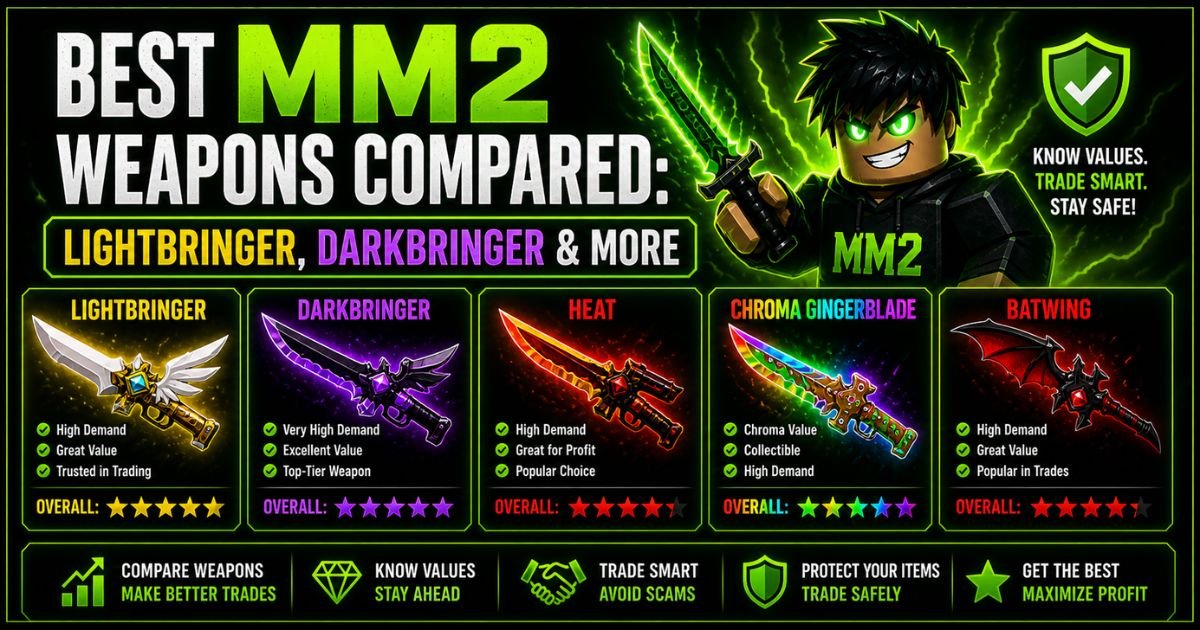
Not every weapon in Murder Mystery 2 is built the same. Some look incredible but trade poorly. Others seem plain at first glance but hold serious value because of a limited release history that most players never think to research. If you are comparing the best MM2 weapons and trying to figure out which ones are genuinely worth pursuing versus which ones just look good in a YouTube thumbnail, this guide was written specifically for you.
The weapons covered here, including Lightbringer, Darkbringer, Fang, Corrupt, Elderwood Scythe, and Hallows Edge, are among the most frequently discussed and most actively traded items in the entire MM2 economy. Each one has its own story, its own community reputation, and its own quirks when it comes to trading. Understanding those details gives you a meaningful edge over traders who look at a weapon and only see its current price without understanding why that price exists or whether it is likely to hold.
This is not a surface-level list article. Every weapon here gets a genuine breakdown covering its visual identity, availability history, trading behavior, collector appeal, and how it performs in real negotiations. By the time you finish reading, you will have a clearer picture of the MM2 weapon landscape than the majority of active traders do.
👉 For a complete trade decision, use our MM2 Trade Value Checker to check if your trade is win, fair, or lose instantly.
1. How MM2 Weapon Value Actually Works
Before comparing individual weapons, it is worth spending time on the mechanics that actually determine why one weapon is worth more than another. This section matters because a lot of players skip this thinking entirely and jump straight to checking prices without understanding what drives those prices in the first place. That gap in understanding is exactly what gets people into bad trades.
MM2 weapon value is built on three overlapping factors: scarcity, demand, and community perception. Scarcity refers to how many copies of a weapon exist in the game and whether new ones can still enter circulation. Demand refers to how many active traders want that weapon at any given moment. Community perception is more subtle but equally real. It is the accumulated reputation a weapon builds over time through community discussions, YouTube coverage, and the general sense of prestige that develops around items that serious traders are known to covet.
What makes this system interesting is that these three factors do not always move in the same direction. A weapon can be genuinely scarce but have low demand because nobody particularly wants it. A weapon can have high demand but relatively steady supply, which prevents its price from climbing the way you might expect. The weapons that consistently command top value in MM2 are the ones where all three factors align: limited supply, persistent demand, and a strong reputation that reinforces both.
Another layer that most new traders miss is the difference between current value and intrinsic value. Current value is what the community is trading a weapon for right now. Intrinsic value is what the weapon is actually worth based on its history, rarity, and long-term demand fundamentals. These two numbers are not always the same. Hype cycles can push current value above intrinsic value temporarily, and quiet periods can suppress current value below where a weapon’s fundamentals say it should sit. The traders who understand this distinction are the ones who know when to buy and when to sell.
👉 For a complete value list, use our MM2 Value List to check if your trade is win, fair, or lose instantly.
2. Lightbringer: Why This Weapon Has Stayed Relevant for Years
Lightbringer is not just popular because it looks good. It has earned its standing in the MM2 weapon hierarchy through a combination of visual design, limited availability, and the kind of long-term community recognition that most weapons never achieve. Players who have been trading in MM2 for several years treat Lightbringer as a reference point weapon. When someone is trying to explain the value of another item, they will often use Lightbringer as the comparison baseline because almost every serious trader knows exactly what it is worth.
The visual design of Lightbringer is genuinely striking without being overwhelming. Its bright, light-based aesthetic creates a visual identity that reads clearly during gameplay and in trade windows, which matters more than it might seem. Weapons that are easy to recognize and visually memorable tend to generate stronger emotional responses from traders, and emotional responses drive demand. This might sound abstract, but it shows up in concrete ways when you are in a negotiation and the other party sees Lightbringer in your offer. Recognition translates to willingness to engage seriously with the deal.
From an availability standpoint, Lightbringer was not a weapon players could pick up from a standard rotating shop. Its release history involved specific limited windows that created a natural supply ceiling. Players who obtained it during those windows and held onto it have benefited from value appreciation over multiple trading cycles. The weapon has proven itself as a reliable store of trading value rather than a short-term hype item that spikes and crashes.
2.1 Lightbringer as a Trading Asset
What makes Lightbringer particularly useful from a trading strategy perspective is its combination of high liquidity and strong value retention. Liquidity in the MM2 context means how easily you can find a buyer or trading partner for an item when you want to move it. Lightbringer scores high on this measure because the demand for it is consistent across many different types of traders, not just a narrow collector segment.
When you place Lightbringer in a trade offer, you rarely need to explain what it is or why it is there. Both parties in the negotiation understand its approximate value and the conversation can focus on whether the overall trade is balanced rather than getting bogged down in what Lightbringer itself is worth. That efficiency in negotiation is genuinely valuable, especially in complex multi-item trades where time and attention are limited.
Lightbringer also performs well as a hold during market downturns. When overall trading activity slows and the demand for many items softens, weapons with strong community reputations like Lightbringer tend to hold their value better than items that were riding shorter-term demand spikes. This relative stability makes it a sensible anchor for any serious trading inventory.
Check out this tool: MM2 Demand Calculator – Accurate Trade Score Tool
3. Darkbringer: The Shadow Aesthetic That Commands Real Market Respect
Darkbringer is one of those weapons that demonstrates clearly how much visual identity matters in the MM2 economy. Its design sits at the opposite end of the visual spectrum from Lightbringer, featuring a dark, dramatic aesthetic that has built an intensely loyal following among a specific but significant segment of the player base. But calling Darkbringer just a visual counterpart to Lightbringer undersells what makes it genuinely interesting as a trading asset.
The community that gravitates toward Darkbringer is not just a random group of players who happen to prefer dark colors. It is largely made up of collectors who deliberately curate their inventories around a specific visual identity, and dark or shadow-themed inventories are among the most common and most admired collection styles in MM2. This means Darkbringer does not just have general demand. It has concentrated demand from a group of traders who specifically want it and who are often willing to pay a premium to complete their themed collections. That concentrated demand dynamic is something a lot of casual price-checkers never account for.
Historically, Darkbringer and Lightbringer have traded at comparable values with the specific gap between them shifting based on which direction community interest is leaning at any given moment. Neither weapon has established a permanent premium over the other in any sustained way. Instead, they function almost like competing versions of the same high-value tier, each with its own loyal buyer base and each with its own moments of relative strength in the market.
3.1 Darkbringer vs Lightbringer: Direct Head-to-Head
| Comparison Point | Lightbringer | Darkbringer |
|---|---|---|
| Visual Identity | Bright, light-based, clean | Dark, dramatic, shadow-themed |
| Primary Collector Appeal | General high-value traders | Dark-themed inventory builders |
| Community Recognition | Very high | Very high |
| Trade Liquidity | High | High |
| Value Stability Over Time | Strong | Strong |
| Seasonal Demand Shifts | Relatively consistent | Can spike with dark-themed events |
| Best Strategic Use | General anchor asset | Targeted trade with themed collectors |
| Availability History | Limited release windows | Limited release windows |
The practical takeaway from this comparison is that neither weapon is universally superior. If you are trading with someone who specifically collects dark-themed items, Darkbringer may command a premium in that specific negotiation that would not exist in a deal with a trader who has no thematic preference. Context matters enormously when trading weapons with strong visual identities.
4. Fang: The Weapon That Serious Traders Actually Respect
Fang does not generate the same kind of dramatic community discussion as Lightbringer or Darkbringer. It does not appear in dramatic YouTube thumbnails as often. Its design is clean and understated rather than visually striking in an obvious way. And yet, ask any experienced MM2 trader about Fang and you will get a response that is notably more respectful than the weapon’s relatively low profile might suggest.
The reason for that respect is simple. Fang works. It trades reliably, holds its value consistently, and fills a role in the MM2 economy that flashier weapons often cannot fill as effectively. Fang is what traders sometimes call a workhorse weapon. It is not the centerpiece of a dramatic high-stakes deal. It is the item that fills a value gap cleanly, gets accepted without argument, and lets a deal close that might otherwise stall over a valuation disagreement about a less recognized item.
The value of a weapon that everyone can agree on the price of cannot be overstated in an economy driven by negotiation. When you add Fang to a trade offer, the other party does not need to look it up. They do not need to argue about whether your source is more accurate than theirs. They know what Fang is worth within a reasonable range, they accept that number without friction, and the conversation moves forward. That frictionless quality is something you genuinely only appreciate after you have been stuck in a negotiation that stalled because one party pulled out an obscure item the other had never heard of.
4.1 Where Fang Fits in Your Trading Strategy
Fang is most valuable as a bridge asset and a flexibility tool. In practical terms, this means you should think about Fang not as a trophy item to display at the top of your inventory but as a tool that enables deals. When you are working toward a higher-value item and your current assets do not quite reach the required value, Fang is the kind of weapon that can fill the gap without creating negotiation drama. When you need to balance out an uneven trade without offering something that might be perceived as filler, Fang reads as a legitimate contribution to the offer.
Keeping at least one Fang equivalent in your inventory at most times is a practical strategy that experienced traders quietly follow. The ability to fill a value gap cleanly and quickly without having to hunt for a specific item can be the difference between closing a deal in the moment versus losing it to a trading partner who moves on while you are searching your inventory for something that works.
Also, this tool: MM2 Trade Risk Analyzer – Safe or Loss Check Tool
5. Corrupt, Elderwood Scythe, and Hallows Edge: The Specialists
Not every high-value MM2 weapon follows the same formula. Lightbringer, Darkbringer, and Fang all have broad appeal across the general trading population. The three weapons in this section work differently. Each one serves a specific segment of the MM2 market, and that specificity is actually a strength rather than a limitation. Corrupt draws in prestige-focused collectors. Elderwood Scythe attracts players who want something visually distinct from the sea of knives and guns that make up most inventories. Hallows Edge rewards traders who understand that timing matters as much as the item itself. If you own any of these weapons or are considering trading for one, understanding who actually wants them and why is the most important thing you can know before entering a negotiation.
5.1 Corrupt: Prestige Without Overexposure
Corrupt is a weapon that many traders have heard of but relatively few actually own, and that ratio is a big part of what makes it interesting. Its value is supported not just by what the community lists say it is worth but by the simple reality that you do not see it in trade offers very often. Scarcity in the active trading market, meaning the number of copies being actively offered for trade at any given time, is different from the total number of copies that exist in the game. Corrupt has both forms of scarcity working in its favor.
The weapon’s visual design is bold and immediately recognizable to anyone who has been trading in MM2 for a reasonable amount of time. It carries the kind of understated prestige that comes from being known as a serious item without being so common that every other trader you encounter has one. Owning Corrupt signals a level of trading depth that most players have not reached, which is part of why it remains consistently sought after even in periods when other high-tier items soften in price.
For traders who are looking to move up from the standard high-end range into items that carry genuine collector prestige, Corrupt represents a meaningful milestone. Getting one through trading requires either a significant accumulation of lower-tier assets or direct access to another Corrupt holder who is willing to deal. That barrier to entry is itself a value driver that shows no signs of weakening as the overall MM2 trading community grows.
5.2 Elderwood Scythe: The Item That Stands Apart Visually
Elderwood Scythe exists in a category almost by itself because of its form factor. The overwhelming majority of weapons in MM2 are knives and guns. Scythes are genuinely unusual, and that unusualness creates a type of demand that does not exist for any knife or gun, regardless of how impressive it is. There are traders in MM2 who specifically want to own a scythe, and Elderwood Scythe is one of the very few options that satisfy that want.
This niche demand dynamic means Elderwood Scythe does not always appear as highly valued as it actually is on standard value lists, because those lists reflect average community pricing rather than the premium that a motivated scythe-specific buyer will pay. If you are trading with someone who specifically wants a scythe to complete a collection or fill a visual gap in their inventory, you may be able to command significantly above the listed value because you have exactly what they want and alternatives are limited.
The visual design itself is impressive regardless of its form factor. The organic, wood-and-nature aesthetic stands out dramatically from the darker and more metallic designs that dominate the high-value weapon pool. For players building inventories with intentional visual variety, Elderwood Scythe fills a space that nothing else in the same tier quite replicates.
5.3 Hallows Edge: Timing Is Everything
Hallows Edge is a textbook example of a weapon whose trading value is fundamentally tied to the calendar rather than to any fixed market position. As a Halloween-affiliated seasonal weapon, it experiences demand cycles that are predictable to the point where you can almost set a calendar reminder for when to hold and when to trade.
In the off-season, specifically from late winter through summer, Hallows Edge trades at its lowest values. Demand is soft because Halloween is far away and the traders who specifically want it are not actively seeking it. In late summer and into fall, as the MM2 Halloween event cycle approaches, demand starts to pick up noticeably. Players who want to build or complete Halloween-themed inventories start looking, and the pool of available Hallows Edge copies in the active market has not yet expanded to meet that demand. That supply-demand gap is where the price premium lives.
Experienced traders who understand this cycle use Hallows Edge as a seasonal arbitrage opportunity. Buy in the low-demand off-season, hold through the buildup period, and sell at peak seasonal demand. The execution is straightforward, the returns are consistent, and the strategy does not require high capital to participate in. Even a single copy of Hallows Edge can deliver meaningful value appreciation if timed correctly.
6. Complete Weapon Comparison Table
| Weapon | Tier | Obtainable Now | Visual Identity | Trading Liquidity | Value Trend | Collector Appeal | Best Trading Strategy |
|---|---|---|---|---|---|---|---|
| Lightbringer | High Godly | Limited | Bright, light | Very High | Stable to rising | Broad | Long-term hold or anchor asset |
| Darkbringer | High Godly | Limited | Dark, dramatic | Very High | Stable to rising | Dark/shadow collectors | Target themed buyers |
| Fang | Mid-High Godly | Limited | Sleek, minimal | High | Stable | General traders | Bridge asset in deals |
| Corrupt | High Godly | No | Bold, striking | Moderate | Stable | Prestige collectors | Hold for value appreciation |
| Elderwood Scythe | High Godly | Limited | Organic, scythe | Moderate | Stable | Visual collectors | Target scythe-seekers specifically |
| Hallows Edge | Seasonal Godly | Seasonal | Dark, Halloween | Seasonal | Seasonal spikes | Halloween collectors | Seasonal arbitrage play |
7. Real Trade Scenarios That Show These Weapons in Action
Scenario 1: Lightbringer Anchors a Multi-Item Deal
A trader is trying to acquire a specific Chroma item they have been working toward for several weeks. Their current inventory includes a mix of mid-tier godlies and a Lightbringer. The Chroma seller wants to see something substantial as the anchor of the offer before they will engage seriously. The trader leads with Lightbringer plus supporting godlies. The Chroma seller immediately recognizes Lightbringer’s value, takes the offer seriously, and a deal gets done that would likely have stalled if the trader had led with an equivalent value spread across less recognized items. The lesson here is that name recognition creates negotiation momentum.
Scenario 2: Darkbringer Meets a Themed Collector
A trader with Darkbringer encounters a player in a trading server who is clearly building a dark-themed inventory. They have several dark-aesthetic weapons already and are actively seeking more. The trader recognizes the opportunity and offers Darkbringer at slightly above the listed value, citing the specific fit with the buyer’s collection. The buyer accepts without meaningful resistance because they know alternatives are limited and Darkbringer is exactly what completes their inventory goal. The same trade with a non-themed buyer would have required more negotiation. The seller got a premium specifically because they matched the right weapon to the right buyer.
Scenario 3: Hallows Edge Off-Season Acquisition
During late spring, a trader spots Hallows Edge being offered in a trading server at a price that reflects the current low seasonal demand. They acquire it knowing that in four months the value will likely be noticeably higher as the Halloween event cycle approaches. When fall arrives and demand spikes, they move it at peak pricing. The profit on the trade was not enormous, but it required no special skill or rare knowledge. It just required understanding the seasonal cycle and having the patience to hold the weapon through the low-demand period. This kind of patient, calendar-aware trading is one of the most accessible advanced strategies in MM2.
Also Read: How to Avoid MM2 Scams – Safe Trading Guide
8. Common Mistakes Traders Make With These Weapons
- Confusing visual appeal with trade value. A weapon that looks impressive in a screenshot does not automatically trade well. Always verify actual community demand and current value list data before making assumptions based on how a weapon looks.
- Treating Lightbringer and Darkbringer as interchangeable in negotiations. While their general value range is similar, using them interchangeably in trade math without checking the current specific values for each can lead to small but consistent valuation errors that accumulate over time.
- Using Fang as filler without verifying its current value. Fang’s broad recognition can create a false sense of certainty about its value. Always check current listings because even reliable workhorse weapons shift in price around new releases and event cycles.
- Ignoring Corrupt because it does not appear often in casual trades. Lower trade frequency is not a negative signal for Corrupt. It is a natural result of the weapon being tightly held by collectors who do not need to trade it. Recognizing this prevents you from underpricing Corrupt when you encounter it.
- Trading Hallows Edge outside its seasonal demand window without accounting for timing. Moving a seasonal weapon during its low-demand period means accepting below-peak value. Unless you have a specific reason to liquidate it during the off-season, holding through to peak demand is almost always the better financial decision.
- Not considering collector premiums in negotiations. Standard value lists reflect average market prices, not the premium a motivated collector will pay for an item that specifically fits their inventory goals. Elderwood Scythe, Darkbringer, and Hallows Edge are all weapons where collector premiums can meaningfully exceed listed values in the right negotiation context.
9. Smart Trading Tips for Each Weapon Type
- For Lightbringer: Use it as your anchor piece in high-stakes negotiations. When you are putting together a complex offer involving multiple items, lead with Lightbringer if you have it. Its recognition value creates credibility and seriousness from the opening of the negotiation, which sets a better tone for the entire deal.
- For Darkbringer: Seek out themed collectors rather than general trading servers. The premium you can achieve from a dark-aesthetic collector who specifically wants Darkbringer to complete their inventory is consistently above what you will get from a standard trade post in a general server. Put in the extra step of identifying your buyer before initiating the trade.
- For Fang: Keep it as a permanent bridge tool in your inventory. Resist the temptation to trade it away for marginal gains. The ability to fill value gaps quickly and without friction in negotiations is worth more over time than the small incremental gain you might get from trading Fang away and replacing it with something of slightly higher value that does not serve the same bridging function.
- For Corrupt: Patience is the entire strategy. Corrupt is not a weapon you should be flipping frequently. Every time it changes hands it has to find a buyer who values it appropriately, and those buyers exist but are not on every corner. Hold Corrupt until you have a genuinely strong offer or until you specifically need to liquidate it for a larger acquisition. Impatient selling of Corrupt consistently results in below-value outcomes.
- For Elderwood Scythe: Market it directly to scythe collectors. When you want to move Elderwood Scythe, the general market is not your best venue. Active collectors who specifically want a scythe will pay more than a general trader evaluating it purely by value list numbers. Find those collectors through MM2 trading Discord channels and specialty trading posts.
- For Hallows Edge: Build a seasonal calendar into your trading plan. If you trade MM2 seriously, tracking which weapons have seasonal demand cycles and planning your acquisitions and sales around those cycles is one of the highest-return, low-effort strategies available. Hallows Edge is the clearest example, but the same logic applies to any weapon tied to a specific event or season.
ALSO CHECK: MM2 Trade Suggestion Tool – Smart Trade Decision System
10. Advanced Insights: Reputation, Narrative, and Long-Term Value
Every weapon in this guide has a price. But price alone does not explain why certain weapons stay valuable for years while others fade. The deeper reason is narrative. Each weapon has a story attached to it, and that story creates lasting emotional investment from specific parts of the trading community. Understanding this gives you leverage that a value list simply cannot provide.
10.1 Every Weapon Carries a Story
- Lightbringer stands for longevity. Traders associate it with reliability and long-term value stability.
- Darkbringer stands for identity. It attracts collectors who build their entire inventory around a visual theme.
- Corrupt stands for exclusivity. Owning it signals a level of trading depth most players never reach.
- Elderwood Scythe stands for uniqueness. It fills a visual space nothing else in the game replicates.
- Hallows Edge stands for timing. It rewards traders who understand seasonal cycles and act on them.
These are not marketing labels. They are real perceptions that shape how traders behave when these weapons appear in a deal.
10.2 Why Narrative Creates Pricing Power
A trader who has wanted Darkbringer for months will behave differently in a negotiation than someone with no attachment to it. That emotional investment pushes them closer to the seller’s asking price. They are less likely to walk away over a small gap. They are more likely to add filler to close the deal.
Sellers who understand this dynamic can consistently achieve above-list value. You are not exploiting anyone. You are simply recognizing that your item means more to a specific buyer than a neutral price number reflects.
10.3 How to Use This in Real Trades
Before entering a negotiation, ask yourself three quick questions:
- Who specifically wants this weapon and why?
- What role does it play in their collection goals?
- Are there easy alternatives for them, or is this their best option right now?
If you can answer all three, you walk into the deal with context that gives you a real edge. Raw value data tells you the floor of the negotiation. Community narrative tells you where the ceiling actually sits.
Conclusion
The best MM2 weapons are not the ones that simply show the highest number on a value list today. They are the ones that combine real scarcity, genuine community demand, and the kind of narrative identity that keeps traders interested over long periods. Lightbringer and Darkbringer lead this group because they deliver on all three dimensions simultaneously. Fang earns its reputation through consistent utility rather than dramatic value. Corrupt maintains prestige through controlled scarcity and collector demand. Elderwood Scythe occupies a unique visual space that nothing else replicates. Hallows Edge rewards the traders who understand and respect seasonal cycles.
What all of these weapons share is that their value is not accidental. It was built over time through the specific way each weapon entered the game, the community that formed around it, and the trading behavior that has developed around it across many seasons. Understanding that story, not just the current price, is what separates traders who consistently build strong inventories from those who always seem to be one trade behind where they want to be.
FAQs
Which MM2 weapon holds its value the best over time?
Lightbringer and Darkbringer have both demonstrated strong value retention over multiple trading cycles, making them among the most reliable long-term holds in the game. Their combination of broad community recognition, limited availability history, and consistent demand across different types of traders gives them better downside protection than most other weapons in a similar value range.
Is Fang worth trading for if I already have similar godlies?
Yes, because Fang’s value in a trading inventory is not primarily about its price relative to other godlies but about its utility as a bridge asset in negotiations. Having a weapon that every trader recognizes and accepts without argument is worth keeping even if you already have godlies with similar or slightly higher values, because those other godlies may not serve the same frictionless bridging function in actual deals.
Why does Corrupt trade less frequently than other weapons at its value level?
Corrupt trades less frequently because the traders who own it tend to be experienced collectors who hold their assets intentionally rather than flipping them for short-term gains. This is actually a sign of the weapon’s quality rather than a weakness. Low trading frequency combined with stable demand means that when Corrupt does appear in an offer, the seller typically has meaningful negotiating leverage.
How much does the seasonal timing affect Hallows Edge’s value?
The seasonal effect on Hallows Edge is meaningful and consistent enough that traders who specifically track it can use it as a reliable strategy. Off-season values can be noticeably lower than peak-season values around the Halloween event cycle. The exact premium varies by year depending on how much new supply enters the market during any given Halloween event, but the directional pattern of lower off-season and higher peak-season pricing has been consistent historically.
Should a beginner focus on acquiring Lightbringer or start with more accessible weapons first?
Beginners should build their foundation with more accessible godlies first and develop a genuine understanding of MM2 trading mechanics before targeting Lightbringer directly. Acquiring Lightbringer requires meaningful trading capital and the ability to evaluate complex multi-item deals accurately. Jumping to high-value weapons before developing those skills often results in overpaying or making structural trade errors that set back inventory progress significantly.
