
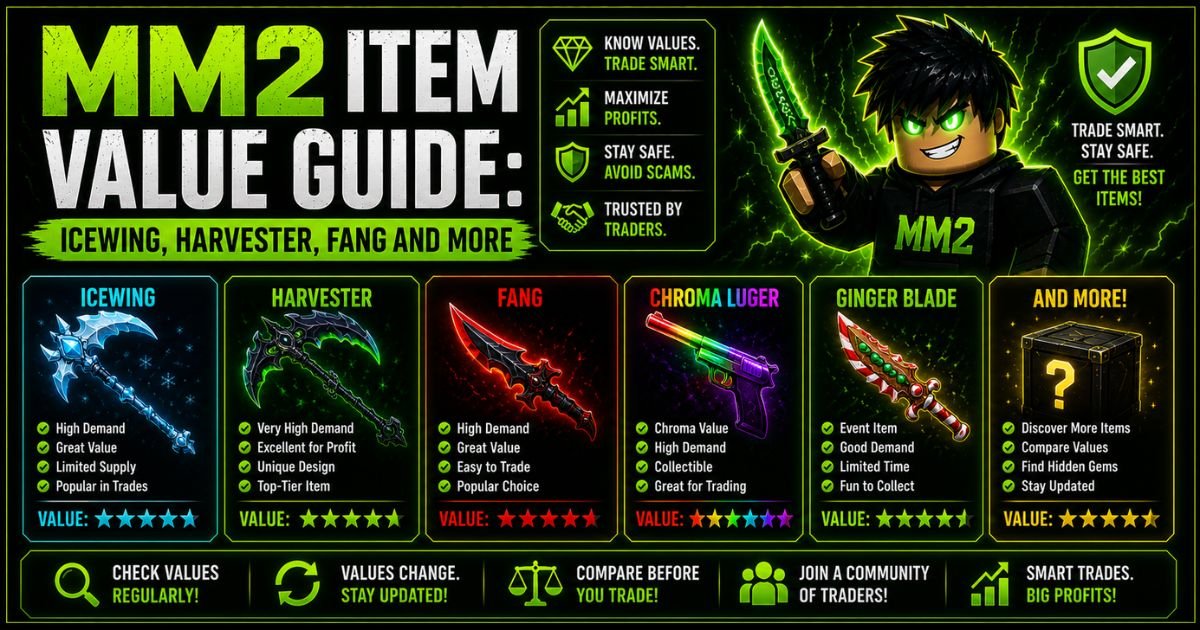
Understanding item values in Murder Mystery 2 is not as simple as looking up a number on a list and treating it as fact. The real MM2 item value guide goes deeper than that.
It explains why specific weapons like Icewing, Harvester, and Fang hold the values they do, what forces push those values up or down over time, and how you can use that understanding to make consistently better trading decisions.
Most players who get into MM2 trading start by memorizing prices. That approach works well enough for basic godly trades, but it breaks down quickly once you deal with items that have seasonal patterns, limited histories, or collector-specific demand.
- Icewing is valued differently depending on the time of year.
- Harvester carries weight in collector circles that its raw price does not fully reflect.
- Fang works differently from both because its value comes from utility, not rarity.
This guide covers each of these items in the depth they deserve. By the end, you will know how each weapon fits the broader MM2 trading economy and how to approach negotiations involving any of them with real confidence.
👉 For a complete trade decision, use our MM2 Trade Value Checker to check if your trade is win, fair, or lose instantly.
1. Why Item Values in MM2 Are Never Just a Single Number
One of the most important things any MM2 trader needs to accept early is that every item value is a range, not a fixed point.
Community value lists like MM2Values and Supreme Values assign numbers to items, but those numbers are snapshots of a constantly moving market. The moment an event ends, a new weapon releases, or a discontinued item returns, the entire trading ecosystem shifts.
Icewing, Harvester, and Fang are not generic common godlies that trade at predictably stable prices. Each one has specific characteristics that create meaningful price variation depending on when, where, and with whom you are trading.
The value range for any given item is shaped by four key forces:
- Supply: How many copies exist and whether new ones can still be created sets the long-term floor.
- Active demand: How many traders want the item right now creates the ceiling.
- Community perception: The reputation an item has built over time determines where between floor and ceiling most trades land.
- Timing: Seasonal cycles, recent events, and broader market activity shift all three variables at once.
A player who treats value list numbers as absolute prices will consistently overpay when buying or undercharge when selling. They are not accounting for the factors that push prices above or below the listed midpoint.
When you start thinking about item values as dynamic ranges rather than fixed prices, your whole approach to trading changes. You stop arguing about whose list is right and start focusing on where within the range the current deal should land. That shift is worth more than memorizing any single item’s price.
👉 For a complete Value list of items, use our MM2 Value List to check if your trade is win, fair, or lose instantly.
2. Icewing: A Weapon Where Timing Changes Everything
Icewing is one of the most recognizable seasonally influenced weapons in all of MM2 trading. Its ice and winter visual themes have earned it a dedicated following among players who build collections around atmospheric or elemental aesthetics.
But what makes Icewing genuinely interesting as a trading subject is not just its design. It is the predictable relationship between its availability, the MM2 event calendar, and the demand cycles that create consistent opportunities for traders who pay attention.
During winter-themed events in MM2, demand for Icewing rises noticeably. Players seeking to complete ice-themed inventories become active buyers. The relatively limited pool of available copies means even a modest increase in buyer activity pushes prices above their off-season average.
Many traders observe this pattern. Very few actually plan around it. That gap between observation and action is exactly where real trading advantage lives.
The supply side matters equally. Icewing copies from very specific event windows that have since closed permanently behave very differently from versions available through multiple event cycles. Before any significant trade involving Icewing, knowing which version you are dealing with is essential groundwork.
2.1 Trading Icewing Based on Market Timing
The practical Icewing strategy is built around two distinct market phases:
Phase 1: The Off-Season
- Winter events are not active.
- General interest in ice-themed items is at its lowest.
- Motivated sellers accept lower prices because buyer activity is soft.
- This is your acquisition window.
Phase 2: The Demand Buildup
- Starts several weeks before major winter events.
- Active buyers enter the market seeking themed items.
- Holders recognize the opportunity and tighten supply by choosing to wait.
- Prices move upward toward their seasonal peak.
Traders who acquired Icewing during the off-season and held through the buildup consistently achieve better outcomes than those who sell during low-demand periods.
This is not a complicated strategy. It requires patience, basic knowledge of the MM2 event calendar, and the discipline to hold an asset through a quiet period. But it consistently delivers results, which is more than most short-term trading approaches can claim.
2.2 Icewing in Multi-Item Trade Negotiations
Beyond seasonal timing, Icewing has characteristics that affect direct negotiations in a specific way.
Its visual identity is strong enough that traders specifically seeking it will often pay above neutral market price because alternatives are limited. A weapon with a genuinely distinctive aesthetic fills a gap that cannot easily be satisfied by offering something else at equivalent list value.
When you are the seller, recognizing who you are dealing with shapes how firm you can be:
- Collector buyer: Higher motivation, fewer alternatives, more willing to pay a premium.
- General trader: More price-sensitive, evaluating purely by the value list midpoint.
Adjusting your approach based on buyer type is a practical skill that improves with experience and pays off consistently across many trades.
ALSO CHECK: MM2 Inventory Value Calculator – Check Your Total MM2 Worth
3. Harvester: Understanding Collector Demand Beyond the Price List
Harvester illustrates one of the most important principles in MM2 item valuation. Collector demand and general market demand are not the same thing, and the difference between them creates opportunities that price lists alone will never reveal.
On a standard value list, Harvester sits at a specific number that reflects the average trade price across the community. But that average masks the reality that certain buyers will pay meaningfully above it because of what Harvester means to them specifically.
Collectors who build inventories around harvest, autumn, or reaper-adjacent visual themes treat Harvester as a priority acquisition. For these buyers:
- Alternatives are limited.
- Motivation to acquire the exact item is high.
- The emotional investment pushes their ceiling above what general market data suggests.
Understanding this distinction changes how you should think about holding Harvester. Purely by listed value, it looks like one of many items at its tier. But with the right buyer, it has a practical ceiling that its list value does not capture.
3.1 How to Identify the Right Buyers for Harvester
Finding buyers who will pay collector-level premiums requires more targeted effort than posting in a general trading server and waiting for offers.
General trading environments bring in a broad mix of buyers who evaluate your item against the value list. Most will not go above it without a specific reason.
The more effective approach is to engage directly with spaces where collectors congregate:
- Discord servers dedicated to themed inventory building.
- Halloween and autumn aesthetic trading groups.
- Communities focused on rare and distinctive weapon collecting.
When you bring Harvester to a space where people already know why they want it, the negotiation dynamic shifts significantly in your favor. You do not need to explain the item’s appeal from scratch. The buyer already understands the value.
3.2 Harvester as a Long-Term Holding Asset
Like most items with strong collector demand and limited supply, Harvester benefits from patient holding strategies.
Sellers who move it quickly during low-demand periods because they want to convert it into something else typically leave real value on the table. The collectors who specifically want Harvester are always out there, but they are not always actively searching at the exact moment you decide to sell.
Holding Harvester until you are actively engaged with its specific collector market, rather than listing it in a general server and taking whatever comes, is a consistent way to achieve above-average outcomes. The difference between a patient-targeted sale and a quick general sale can be significant enough to justify the extra time and effort.
Check this tool: MM2 Scam Checker Tool – Avoid Murder Mystery 2 Scams
4. Fang: The Reliable Workhorse of Mid-High Tier Trading
Fang occupies a unique position in the MM2 item value landscape. Its strength comes not from extreme rarity or strong collector identity but from something more practical and arguably more durable: universal recognition and consistent broad demand.
Almost every serious MM2 trader knows what Fang is, knows approximately what it is worth, and has encountered it enough times to evaluate it quickly without research. That combination of familiarity and reliability makes Fang function differently from most items at its value tier.
The design of Fang is clean and straightforward without being generic. It has enough visual character to be recognizable and respected, without being so niche that only a specific collector type wants it. That broad aesthetic appeal contributes directly to the consistent demand that makes Fang so useful as a trading tool.
From a supply perspective, Fang’s availability history has created natural scarcity that supports its value without pushing it into extreme rarity territory. The balance between meaningful scarcity and practical accessibility is actually quite difficult to achieve in a trading economy, and Fang sits in that sweet spot in a way that makes it consistently useful across many different trading situations.
4.1 Using Fang as a Strategic Trade Tool
The most sophisticated way to use Fang is as a bridge asset. A bridge asset is an item that fills a value gap in a complex offer cleanly and without creating negotiation friction.
When you are putting together a multi-item offer that needs one more recognizable piece to reach the seller’s required value, Fang serves that role better than most alternatives because:
- Both parties can agree on its approximate worth without argument.
- It does not require explanation or verification from either side.
- It keeps negotiations moving forward rather than stalling over minor valuation disputes.
Experienced traders who understand this keep Fang in their inventory not because it is their most valuable item but because it is one of their most versatile ones.
4.2 When Fang Is the Right Item to Lead With
While Fang typically works best as a supporting piece, there are situations where leading with it makes strategic sense:
- When the other trader has specifically indicated interest in Fang.
- When their inventory composition suggests they would value it as a specific acquisition.
- When you want to establish common ground quickly at the start of a complex negotiation.
In these situations, leading with Fang creates immediate mutual understanding. The buyer already has a mental valuation for it, and the rest of the offer lands in a more receptive environment because the anchor item is exactly what they came for.
5. Other Notable MM2 Items in This Value Range
Not every high-value item in this tier is covered by Icewing, Harvester, and Fang alone. Several other weapons regularly appear in trades at this level and deserve their own focused discussion.
Each one below has a distinct identity, a specific history that explains its current value, and a particular type of buyer who wants it most. Understanding all three of those things for each item gives you the complete picture you need to trade them intelligently.
5.1 Luger and Chroma Luger: The Classic Pairing
Luger is one of the most historically significant weapons in MM2 trading. Its standard version serves as a reliable mid-high godly with consistent demand across a broad range of traders.
Chroma Luger adds the distinctive color-shifting visual effect that defines the Chroma category and commands a meaningful premium above the standard version.
What makes this pairing interesting from a strategy perspective is that the gap between Luger and Chroma Luger has remained relatively stable over time. This stability makes the Chroma upgrade a fairly predictable value proposition when crafting materials are available.
Key points to know:
- Traders who craft Chroma Luger during events when materials are accessible often find the finished item is worth meaningfully more than the combined input value.
- Post-event, when materials can only be acquired through trading, the crafting margin narrows significantly.
- The best time to consider this craft is during active event windows, not after them.
5.2 Candy Knife: Seasonal Value With Strong Community Identity
Candy Knife has a visual identity that sits completely outside the darker, more aggressive aesthetic dominating most of the MM2 high-value weapon pool.
Its bright, candy-themed design appeals specifically to players who want their inventories to reflect a more playful or colorful aesthetic. That specific appeal creates a consistent buyer pool that general value metrics do not always capture accurately.
Like other event-tied items, Candy Knife experiences demand cycles tied to specific times of the year. Traders who understand these cycles use the same seasonal arbitrage approach that works for Icewing:
- Acquire during low-demand periods when motivated sellers are soft on price.
- Hold through the buildup toward the relevant seasonal event.
- Sell into peak demand for better overall outcomes.
5.3 Seer: The Long-Standing Community Reference Point
Seer is one of the oldest and most referenced weapons in MM2 trading history. Its significance goes beyond its current trade value because it has functioned for years as a common reference point in community discussions about item pricing.
When traders want to communicate approximate value casually, Seer often comes up as the comparison baseline for mid-tier godly items.
Owning Seer or its Chroma variant is not just about holding a specific value level. It is about having an item that every trader in the community recognizes and respects as a legitimate piece of MM2 trading history. That historical dimension adds a layer of community value that purely modern items at the same price tier simply do not have.
ALSO READ: What Is WFL in MM2 Trading? Win, Fair, Lose Explained
6. Complete Item Value Comparison Table
| Item | Type | Seasonal Influence | Collector Demand | Trade Liquidity | Value Stability | Best Strategy |
|---|---|---|---|---|---|---|
| Icewing | Seasonal Godly | High, winter-tied | Ice and winter collectors | Moderate | Seasonal variation | Buy off-season, sell at peak |
| Harvester | Godly | Moderate, autumn-tied | Harvest and reaper collectors | Moderate | Stable with collector premium | Target specific collector buyers |
| Fang | Godly | Low, consistent | Broad general demand | High | Very stable | Bridge asset in complex trades |
| Chroma Luger | Chroma Godly | Low | Broad Chroma demand | High | Stable | Craft during events for profit |
| Candy Knife | Seasonal Godly | Moderate | Playful aesthetic collectors | Moderate | Seasonal variation | Seasonal arbitrage |
| Seer | Godly | Low | Community reference item | High | Very stable | Long-term hold or filler |
7. Real Scenarios: These Items in Action
Scenario 1: Icewing Seasonal Play Executed Correctly
A trader notices Icewing being offered in trading servers during late spring at off-season prices. The seller wants to liquidate quickly. The buyer acquires it at a lower price and holds through summer without actively trying to trade it.
When the MM2 community begins anticipating winter events in early fall, demand for Icewing picks up noticeably. The buyer sells into renewed interest and achieves a return well above what they paid just a few months earlier.
The strategy required no special skill. Just an understanding of how seasonal demand cycles work for themed weapons and the patience to wait.
Scenario 2: Finding the Right Harvester Buyer
A trader lists Harvester in a general trading server and receives only lowball offers from buyers evaluating it purely against the value list midpoint.
They take a different approach and engage directly with a Halloween and autumn-themed trading community on Discord. Within a short period, they encounter a collector who has been specifically seeking Harvester to complete a reaper-themed inventory.
That collector offers above list value without significant negotiation because they understand the item’s specific fit for their collection and know alternatives are limited. The seller achieves a significantly better outcome simply by connecting the right item with the right buyer.
Scenario 3: Fang Closes a Deal That Might Have Stalled
Two traders are negotiating a deal involving a mid-range Chroma item. The buyer’s offer is close to acceptable but slightly below the seller’s minimum.
The buyer adds Fang to the offer as a filler piece to close the remaining gap. The seller immediately recognizes Fang, agrees on its value without argument, and accepts the deal.
Without Fang, the negotiation might have stalled over a small discrepancy requiring back-and-forth over less recognized filler items. Fang’s universal recognition allowed the deal to close cleanly in one exchange.
ALSO READ: MM2 Overpay, Underpay & Flipping Guide for Smart Trading
8. Common Mistakes With These Items
- Treating Icewing as a static-value item year-round. Its seasonal demand cycle is real and consistent. Traders who ignore timing regularly accept worse outcomes than they would get with basic calendar awareness.
- Selling Harvester in general servers without targeting collectors. The collector premium only exists when you are selling to buyers who specifically want it. In a general server, most buyers evaluate it against list price and will not go above it.
- Overusing Fang as filler without checking its current value first. Fang is broadly recognized, but its price still moves around event cycles and new releases. Assuming you know what it is worth without checking leads to cumulative valuation errors over time.
- Confusing Seer’s historical significance with its current investment potential. Seer is a great stable asset and community reference point, but historical significance does not make it an appreciating investment in the same way as truly scarce items are.
- Missing the Chroma Luger crafting window. The opportunity to craft profitably exists primarily during events when materials are accessible through active gameplay. Players who miss these windows find that post-event material costs have risen to where the margin has largely disappeared.
- Not researching item versions before trading. For items like Icewing that may have multiple versions from different release periods, the specific version matters significantly for valuation. Always confirm which version you are dealing with before agreeing on a price.
9. Smart Tips for Trading These Weapons Effectively
- Build a seasonal calendar for event-tied items. Icewing, Candy Knife, and similar seasonal weapons follow predictable demand cycles. Mapping the MM2 event calendar and marking buy and sell windows for each seasonal item pays consistent dividends throughout the year.
- Join collector-specific communities before you need them. Connect with Halloween collectors, winter aesthetic traders, and theme-specific groups in advance. When the right time to sell comes, you already have access to the right buyers rather than scrambling to find them.
- Keep Fang or an equivalent bridge asset available at all times. The utility of having a universally recognized filler item available during complex negotiations is something you only fully appreciate after a deal stalls over an obscure filler choice. Maintain at least one reliable bridge asset as a permanent tool.
- Cross-reference both major value lists specifically for these items. Seasonal items like Icewing and Harvester tend to show more variation between MM2Values and Supreme Values than stable standard godlies do. Always check both before any significant negotiation.
- Use Chroma crafting events as active profit windows. Do the math beforehand to identify which crafts have the best margin. Chroma Luger is historically one of the more profitable crafts when materials are accessible, but the math changes each event cycle based on material drop rates and finished Chroma demand.
- Understand that the selling price and the listing price are different things. Many players list items at aspirational prices and negotiate down. Tracking completed trades rather than just active listings gives you a more accurate sense of true market value for items where collector premiums create real price variation.
10. Advanced Insights: Reading Market Signals for Mid-Tier Items
Understanding how to read market signals for items at the Icewing, Harvester, and Fang value level is a skill that takes time to develop but pays off consistently for traders who invest in it.
Unlike top-tier items where price movements are driven by a small group of elite holders, mid-tier items respond to a broader range of market forces that are actually more predictable once you know what to look for.
10.1 Volume as a Demand Signal
When a specific item starts appearing more frequently in trade offers across multiple servers simultaneously, that increased volume signals one of two things:
- Demand is rising and more buyers are entering the market.
- Supply is increasing because holders are choosing to sell.
These two causes have opposite implications for price direction.
- Volume increasing alongside rising prices means demand is driving activity. Holding or raising your asking price makes sense.
- Volume increasing while prices stay flat or decline means new supply is entering the market. The window for premium prices may be closing.
Watching both volume and price direction together gives you a much clearer picture than either signal alone.
10.2 Event Announcements as Advance Indicators
One of the clearest advance indicators of upcoming price movements for seasonal items is the MM2 event announcement cycle.
When developers announce a winter event, demand for winter-themed items like Icewing begins rising before the event actually starts. The same pattern applies to Halloween items, spring items, and any event-tied category.
Traders who act on event announcements rather than waiting for demand to peak consistently achieve better entry and exit prices. By the time demand for Icewing is visibly spiking in trading servers, the best acquisition prices have already passed.
Anticipating the spike based on event timing rather than reacting to it after it happens is a concrete way to get slightly better outcomes across multiple seasonal cycles every year.
10.3 The Role of YouTube and Community Content
Content creator coverage has a measurable impact on item demand in MM2, particularly for items in the mid-high value range covered by this guide.
When a well-followed MM2 YouTuber features a specific weapon in a trading video, demand for that weapon often increases noticeably in the days that follow. This effect typically fades over one to two weeks as the content cycle moves on, but it creates a real short-term price window.
Traders who follow active MM2 content creators can sometimes anticipate these demand spikes by tracking which items are currently being featured and positioning themselves ahead of the broader community reaction. For traders who are already consuming this content regularly, it adds a useful layer of market awareness at no additional cost.
Conclusion
The real MM2 item value guide is not about memorizing numbers. It is about understanding the forces that create and move those numbers across different items and different market conditions.
- Icewing rewards traders who understand seasonal cycles and act on them deliberately.
- Harvester rewards traders who take the time to connect with its specific collector community rather than settling for general market prices.
- Fang rewards traders who recognize that reliability and universal recognition have practical value that shows up consistently in complex negotiations.
The broader lesson from this guide is that every item in MM2 has a specific set of characteristics that determine how it should be approached in the market.
Some items are best as seasonal plays. Some are best as collector-targeted assets. Some work best as utility pieces in complex deals. Knowing which category each item belongs to and adjusting your approach accordingly is the foundation of consistently good MM2 trading.
Apply these principles alongside current value data from both major community lists, stay engaged with the trading community to track real market conditions, and approach every negotiation with the preparation that your items and your trading goals actually deserve.
FAQs
How often do MM2 item values like Icewing and Harvester change?
Values for seasonal items like Icewing and Harvester can shift noticeably over periods of weeks to months depending on event activity and collector demand. They are generally more volatile than standard always-available godlies. Checking both MM2Values and Supreme Values before any significant trade involving these items is important because a price from a few weeks ago may no longer reflect current market conditions accurately.
Is Fang a good item to have in your inventory for trading purposes?
Yes, Fang is one of the more practically useful items to keep available in your inventory because of its universal recognition and consistent broad demand. Its primary value is as a bridge asset that fills value gaps in complex negotiations cleanly and without creating friction. Traders who always have a Fang or equivalent reliable filler piece available consistently close deals more smoothly than those who need to hunt for a suitable filler item in the moment.
Why does Harvester sometimes trade above its listed value?
Harvester trades above its listed value when a collector who specifically wants it for a themed inventory is the buyer. Community value lists reflect average trade prices across all buyer types, but motivated collectors with limited alternatives will often pay above the average. The premium exists specifically in negotiations with this type of buyer and may not be achievable in general trading environments where buyers are evaluating the item against the list price.
What is the best time of year to sell Icewing for maximum value?
The best time to sell Icewing is during the buildup period leading into and through active winter events in MM2. Demand rises as players seek to complete winter-themed inventories and the pool of active sellers typically tightens as holders recognize the seasonal opportunity and choose to wait. Selling during this demand peak generally achieves meaningfully better outcomes than selling during the off-season when buyer activity for winter-themed items is at its lowest.
Is it worth crafting Chroma Luger during events, or should I just buy it through trading?
Crafting Chroma Luger during events when materials are accessible through active gameplay is generally the more efficient approach if you can participate fully in the event. The effective cost of materials earned through gameplay is lower than the market price of those same materials post-event, which means the crafting margin is highest during the event window itself. Post-event, when materials can only be acquired through trading, the margin narrows significantly and buying a finished Chroma Luger directly is often more practical.
