
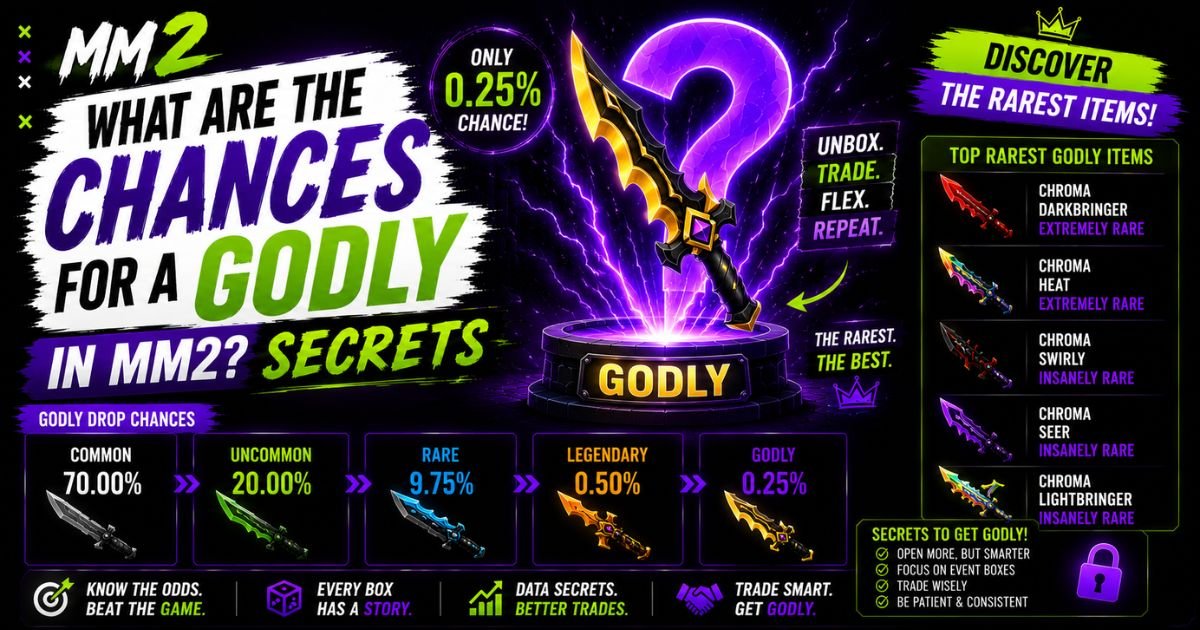
If you have spent any serious time playing Murder Mystery 2 on Roblox, you already know that getting a godly is not something that happens every day. It is the kind of moment that makes players stop, take a screenshot, and run to tell their friends. But most players who grind boxes and trades have one question sitting in the back of their mind: what are the actual chances for a godly in MM2, and which items are truly the rarest in the whole game?
This is not a simple yes or no answer. The chances depend on which box you are opening, whether the item is still obtainable, and whether we are talking about a limited item that only dropped during a seasonal event years ago. After trading in MM2 for a long time and paying close attention to drop rates, community data, and item histories, I want to give you a thorough breakdown of everything related to godly drop chances and rarity in this game.
By the end of this guide, you will understand exactly how rare godlies are, which knife and gun hold the title of rarest in MM2, and how to approach your trading or box-opening strategy with realistic expectations.
🎁 Want to know which Godlies can actually be unboxed? Read our complete MM2 box Godly guide to see every crate and its possible Godly drops.
1. Understanding Godly Rarity in MM2
Before jumping into percentages and specific items, it is important to understand what the godly tier actually means in Murder Mystery 2 and why it carries so much weight in the community. Many newer players hear the word “godly” and assume it just means a good-looking weapon, but the reality goes much deeper than that. The godly tier sits at the very top of MM2’s item hierarchy, above common, uncommon, rare, and legendary. It represents the most exclusive and hardest-to-obtain weapons in the entire game.
Godly items include knives, guns, and in some cases pets. They are visually distinct, often with unique animations, particle effects, and designs that set them apart from every lower-tier item. When you walk into a server with a godly equipped, it immediately communicates your experience and investment in the game. But beyond looks, godlies drive the entire MM2 trading economy. A single godly can be worth dozens of legendaries, and the rarest godlies can command trades worth hundreds of lower-tier items combined.
Understanding the tier structure clearly helps you make smarter decisions whether you are opening boxes, crafting, or trading. Here is how the tiers compare:
| Tier | Approximate Drop Chance | Trading Value | Still Obtainable via Boxes? |
|---|---|---|---|
| Common | 40% to 50% | Almost none | Yes |
| Uncommon | 25% to 35% | Very minimal | Yes |
| Rare | 10% to 20% | Low | Yes |
| Legendary | 5% to 10% | Moderate | Yes (some) |
| Godly | 1% or below | High to Extreme | Some only |
This table makes it clear that godlies exist in a completely different category from everything below them. The jump from legendary to godly is not a single step on a scale. It is a major barrier that requires either extreme luck with boxes, serious crafting investment, or smart long-term trading.
What Is a Godly in MM2?
The godly tier is split further by how items are actually obtained. Some godlies come from standard boxes that are available year-round. Some come from special seasonal event crates that only appear during Halloween, Christmas, or other limited windows. Some were only ever available through a one-time limited release. And then there are Chroma godlies, which are an even rarer variant sitting above standard godlies in terms of scarcity and value.
Each of these subcategories affects how rare any individual godly actually is. A godly you can still open from a current box is fundamentally different in terms of real-world scarcity from a godly that dropped once during a 2018 Halloween event and has never been available again. Both are called godlies, but their rarity is nowhere near the same level.
Godly Demand vs. Godly Rarity
One thing that trips up a lot of players, especially those newer to the trading side of MM2, is confusing demand with rarity. An item can be highly demanded but not particularly rare if it is still actively obtainable through current boxes or crafting. On the flip side, an item can be extremely rare because very few copies exist, but if fewer players are actively seeking it, the price may not reflect that scarcity as strongly.
The most valuable items in MM2 are the ones where high demand and genuine rarity meet at the same time. When an item is both hard to get and widely wanted, that is when you see the trade values that seem almost unbelievable to newer players.
2. What Are the Chances for a Godly in MM2?
This is the core question that brings most players to this topic, and it deserves a thorough and honest answer. The short version is that godly drop rates from standard MM2 boxes sit at approximately 1% or slightly below. But understanding what that number actually means in practice, and how it applies to different box types and methods, is where the real insight comes from.
The developer of MM2, Nikilis, has not published official drop rate tables for most boxes. What the community knows about drop rates comes from large-scale player tracking, where thousands of box openings are recorded and the results are aggregated to produce reliable probability estimates. These community-tracked estimates are what most experienced MM2 players rely on.
Box Opening and the 1% Reality
For most standard boxes in MM2, the godly drop rate is estimated between 0.5% and 1%. That means for every 100 box openings, you might statistically receive one godly. The word “might” is critical here. Each individual box opening is an independent probability event. The game does not guarantee you a godly after 99 failed openings. The 1% chance resets completely with every single box you open.
What this means practically is that bad streaks are entirely normal. Many dedicated players open 200, 300, or even more boxes before landing a single godly. If you go into box opening expecting the math to be kind to you, you will likely end up frustrated. The math simply describes what happens across thousands of openings in aggregate, not what will happen to you personally in your next 100 boxes.
To put this into perspective with probability math: to have roughly a 63% chance of landing at least one godly, you need approximately 100 box openings at a 1% rate. To push that probability to 90%, you are looking at around 230 openings. For a player spending Robux to open boxes, those numbers translate into real costs that often exceed the trading value of the godly you eventually receive.
Seasonal and Limited Box Drop Rates
Event-specific boxes from MM2’s Halloween, Christmas, and other seasonal updates are believed to have carried similar or in some cases slightly different drop rate structures compared to the standard year-round boxes. Some older event crates had narrower item pools, which could affect the practical rate of any specific item dropping even if the overall godly chance was similar.
This is a key reason why old seasonal godlies carry so much more value than standard godlies today. Even if the godly drop rate during the original event was 1%, the event itself only ran for a few weeks. Players who were not actively playing during that exact window had zero chance of obtaining the item, full stop. That hard time boundary is what creates permanent scarcity.
Crafting as a Guaranteed Alternative
MM2 also features a crafting system that gives players a way to obtain godlies without relying on box luck. Crafting requires combining a set number of lower-tier items to produce a higher-tier result. Unlike box opening, crafting is deterministic: if you have the required materials, the craft will succeed every time. There is no luck involved in the crafting step itself.
The challenge is accumulating enough materials. Crafting a godly typically requires a significant stack of rare and legendary items, which themselves take time to collect through grinding and trading. Many players spend weeks or months building up their crafting materials before they can execute a single godly craft. It is a slow process, but for players who want a guaranteed path rather than gambling on boxes, it is often the smarter long-term choice.
Trading Up Over Time
Trading is the third main route to obtaining a godly, and it is the method that most experienced MM2 players rely on to build their collections. If you have been accumulating common, uncommon, and rare items through regular gameplay, you can gradually trade upward through the value tiers until you have enough to acquire a godly through player-to-player exchange.
The key to making this work is understanding current market values, being patient, and avoiding the temptation to rush a trade when you are close to your goal. Rushed trades almost always favor the more experienced party. A player who has been trading for years knows exactly how to recognize someone who is desperate to complete a deal, and they will structure the offer to their own advantage.
🌈 Curious about obtaining even rarer items? Check out our guide to getting Chromas in MM2 to learn how players unlock Chroma weapons.
3. My Real Experience With Godly Drops and Rare Item
I want to be straightforward about what it actually looks like to chase godlies in MM2 from a player’s perspective, because the numbers alone do not capture the full experience. I have spent extended time in MM2 trading servers watching how these items move, tracking which godlies show up regularly and which ones almost never appear, and paying attention to how experienced traders handle acquisitions.
The first thing that stands out when you spend real time in trading servers is how different the atmosphere is around standard godlies versus rare limited items. Standard godlies, things like Elderwood Scythe or Corrupt, cycle through trades regularly. You will see them offered multiple times per session in an active trading server. Traders negotiate, counter-offer, and deals get done within minutes because both parties understand the value and copies are available.
Rare limited items are a completely different story. I have watched trading servers for extended periods and seen items like Batwing or Chroma Darkbringer appear only a handful of times across weeks of observation. When they do appear, the dynamic in the server shifts immediately. Experienced traders who recognize the item pay close attention. The person listing the item almost always knows exactly what they have and will not accept anything they consider below market value. Most of the time, those listings do not result in a completed trade during that session because the asking price is simply beyond what most traders can meet.
This gap between standard godlies and true rare limited items is something you cannot fully appreciate just from reading a value chart. You have to spend time watching the market move in real time to feel how different the supply conditions are. A standard godly feels accessible. A rare limited item feels genuinely scarce in a way that affects every negotiation around it.
Box opening is even more humbling in practice than the numbers suggest. I have seen players open 50, 60, 70 boxes in a single session and walk away with nothing above legendary. The 1% chance sounds manageable until you are actually watching someone go 80 boxes deep without a godly drop. That is when the reality of what these odds mean hits differently.
4. What Is the Rarest Knife in MM2?
The rarest knife question is one that comes up constantly in MM2 communities, and it deserves a careful answer because “rarest” means different things depending on context. There is trade rarity, which reflects how hard an item is to acquire through normal trading today. There is absolute rarity, which refers to how few total copies of an item actually exist across all active accounts. And there is historical rarity, which considers how limited the original acquisition window was.
The items that consistently rank as the rarest knives in MM2 are the ones where all three of these rarity types align at the same time. These are knives that were available only during specific limited events, that have not been re-released, and that exist in small enough numbers that they almost never appear in standard trading servers.
Top Rarest Knives Ranked
Chroma Darkbringer is widely considered one of the rarest obtainable godly knives in the game. The standard Darkbringer is itself a popular and valuable godly knife, but the Chroma variant features a multicolor shifting effect and drops at a rate estimated to be around ten times lower than a standard godly drop within the same box pool. Chroma Darkbringer shows up in trading servers very rarely, and when it does, the asking price reflects its true scarcity.
Batwing is a Halloween-limited godly knife that has only been available during specific seasonal event windows. Players who have it either acquired it during the original event or have made significant trades to obtain it secondhand. Its combination of limited availability and distinctive design makes it one of the most sought-after knives among serious collectors.
Hallows Edge is another Halloween-exclusive godly knife that has been out of active rotation for an extended period. It carries significant nostalgic value among veteran MM2 players and commands high trade values that surprise newer players when they first encounter it in a trade listing.
| Knife Name | Rarity Type | Still Obtainable? | Trade Value Level |
|---|---|---|---|
| Chroma Darkbringer | Chroma Godly | Extremely rarely | Extremely High |
| Batwing | Limited Seasonal | No (event only) | Very High |
| Hallows Edge | Limited Seasonal | No (event only) | High |
| Elderwood Scythe | Standard Godly | Yes (box or craft) | Moderate to High |
| Corrupt | Standard Godly | Yes (box or craft) | Moderate to High |
Why Older Limited Knives Hold Their Value
The reason items like Batwing and Hallows Edge maintain and even increase in value over time is tied directly to supply dynamics. When an item is permanently unavailable through new drops, its supply is fixed. Every inactive account holding one of these knives effectively removes a copy from the tradeable market. Over years of players moving on from the game, that effective supply shrinks while demand among active collectors remains steady or grows. This creates a consistent upward pressure on value that standard godlies, which can still be obtained through current boxes, simply cannot replicate.
💎 Looking for alternative ways to obtain rare weapons? Read our free Godly farming guide for legitimate methods to earn valuable items.
5. What Is the Rarest Gun in MM2?
Guns in MM2 are often overlooked in conversations about rarity because the community tends to focus more heavily on knives. The murderer role in gameplay uses a knife, which naturally draws more attention to that side of the inventory. But the rarest godly guns are every bit as scarce and valuable as the rarest knives, and in some cases they are harder to find in active trading because fewer people specifically seek them.
This relative underattention to guns in the trading community can actually work in favor of players who are specifically interested in building a rare gun collection. Lower active demand sometimes means slightly more favorable trade terms compared to equivalent-rarity knives.
Top Rarest Guns Ranked
Chroma Luger holds a strong claim as the rarest obtainable godly gun in MM2. Like all Chroma items, it dropped at an extremely low rate from box pools, and its availability has been limited for a long time. Players holding a Chroma Luger are sitting on a significant asset within the MM2 economy.
Ghostly is a gun that was available during a limited event and has been out of the standard rotation for years. Its distinct design and permanently limited supply make it a notable item among gun collectors. It appears very rarely in trading servers, and when it does, the asking price immediately signals that the owner is aware of its scarcity.
Laser is an older limited gun that newer players often do not recognize until they have spent serious time in the trading community. Its low circulation means it almost never surfaces in casual trade offers, and tracking one down for purchase requires patience and active monitoring of trading spaces.
| Gun Name | Rarity Type | Still Obtainable? | Trade Value Level |
|---|---|---|---|
| Chroma Luger | Chroma Godly | Extremely rarely | Extremely High |
| Ghostly | Limited Seasonal | No (event only) | Very High |
| Laser | Limited Event | No | High |
| Chill | Seasonal Godly | Occasionally | Moderate to High |
How Gun Rarity Compares to Knife Rarity in Trading
One practical difference between rare guns and rare knives in the MM2 economy is demand-side behavior. Because knives are used in the murderer role, which many players see as the most exciting part of MM2 gameplay, equally rare knives and guns tend to have slightly different trade values, with knives often commanding a small premium. However, certain guns have developed a collector’s status that places them on par with or above equivalent knives in value, particularly among traders who specialize in rare guns.
For players who are building a collection strategically, this demand asymmetry can be useful. Rare guns sometimes trade at slightly more favorable rates relative to their true scarcity because fewer people are actively competing to acquire them.
6. The Rarest Gun and Knife Combined:
When players ask what the rarest gun and knife in MM2 are together, they are really asking about the absolute peak of the MM2 item hierarchy. Getting to that peak requires understanding how multiple rarity factors stack on top of each other to produce items that only a tiny fraction of the player base will ever own.
The items that sit at this peak share a specific set of characteristics: they were only available during a limited time window that has permanently closed, they had low drop rates even during that original window, they exist in small total quantities across the player base, and many of the accounts that originally held them are no longer active. Each one of these factors alone creates scarcity. When all of them apply to the same item simultaneously, the result is something genuinely irreplaceable within the game’s economy.
Common Mistakes Players Make When Judging Rarity
A significant number of players, especially those newer to trading, regularly misjudge item rarity in ways that cost them in trades. One of the most common mistakes is confusing high demand with high rarity. An item can be widely wanted and still be relatively accessible if it is still obtainable through current boxes or crafting. Demand drives price in the short term, but true long-term value is anchored in actual supply scarcity.
Another frequent mistake is assuming that because an item looks impressive or has flashy visual effects, it must be among the rarest in the game. Some of MM2’s most visually striking items are mid-tier godlies that are fairly easy to obtain. Visual quality is a design choice made by the developers, not a reliable signal of an item’s rarity or trading value.
A third mistake is failing to distinguish between items that are temporarily unavailable and items that are permanently retired. Some MM2 seasonal items return on a yearly cycle and will be available again in the next event season. Others have been permanently removed and will never re-enter the game through any official method. That permanent retirement status is the defining factor that separates a merely rare item from a truly irreplaceable one.
Strategy for Building a Rare Item Collection
If your goal is to own some of the rarest items in MM2, a realistic step-by-step approach matters more than luck. Start by building a solid base inventory through box openings and gameplay rewards, focusing on accumulating rare and legendary items. Use a reliable and currently maintained value resource to understand market rates before making any significant trades. Trade upward gradually through standard godlies rather than trying to jump directly from legendaries to ultra-rare items.
Watch trading servers consistently over time rather than checking in occasionally. Rare items surface infrequently, and when they do, being present and prepared matters. Set a clear trade value target for the item you want before entering any negotiation, and do not let excitement push you into accepting terms that do not reflect that target. Finally, pay attention to seasonal events and participate actively during those windows, since event periods are often the only times certain items become temporarily available.
📚 New to MM2 rarities? Explore our MM2 item rarity guide to understand Godly, Ancient, Chroma, and other item tiers.
7. How the MM2 Economy Shapes Rarity Over Time
The MM2 trading economy is not static. It changes continuously as new items are introduced, old event windows close, player behavior shifts, and accounts become inactive. Understanding these longer-term dynamics is what separates casual traders from players who genuinely understand how MM2 value works.
One of the most important forces shaping rarity in MM2 is account attrition. MM2 has been around since 2014, and a meaningful percentage of the accounts that were active during early event seasons are no longer being used. When an account becomes permanently inactive, any rare items it holds are effectively removed from the tradeable market. This process happens slowly but consistently, and it means that the effective supply of old limited items is always shrinking even though no new copies are being destroyed.
Chroma Items as a Separate Rarity Class
Chroma items deserve their own dedicated explanation because they operate under a fundamentally different set of rarity conditions compared to standard godlies. A Chroma item is not simply a rare version of a regular godly weapon. It has its own visual identity, its own position in the trading hierarchy, and its own collector community within MM2.
The Chroma drop rate is estimated at approximately 0.1%, which means it is roughly ten times rarer than a standard godly drop within a box pool that already has a 1% godly rate. When you apply that Chroma drop rate to an item that was only available during a specific limited event window, the resulting effective acquisition chance during the original availability period was extraordinarily small. Players who obtained Chroma versions of limited event items through original drops are holding items that were always going to be extremely scarce.
Using Value Charts Effectively
Experienced MM2 traders do not rely on memory or gut feeling when evaluating trades. They reference value charts regularly, cross-check multiple sources when dealing with high-value items, and pay attention to recent completed trade history in active trading communities. Developing this habit early will protect you from costly mistakes, particularly when dealing with items whose values you are not yet familiar with.
Value charts require active maintenance to remain accurate. An item’s community value from six months ago can differ significantly from its current value, especially if a related item became available through a new event or if community demand shifted. Relying on outdated value data is one of the most common sources of bad trades, particularly for players who are not consistently active in trading spaces.
Conclusion
Understanding what the chances are for a godly in MM2 and knowing which items are truly the rarest requires looking beyond surface-level information. The godly drop chance from standard boxes sits around 1% or below, which makes consistent box opening an expensive and unreliable primary strategy. Crafting offers a guaranteed route but demands significant material investment over time. Trading upward gradually remains the most practical long-term path for most players who want to build a collection without spending heavily on boxes.
The rarest knife and gun in MM2 are not items you will encounter in everyday trading. They are old limited seasonals and Chroma variants that exist in small numbers across the active player base, and owning one places you in a very small group within the MM2 community. The players who successfully acquire these items do so through consistent market awareness, patient trading, and a genuine understanding of how MM2 item value actually works.
Stay consistent, trade smart, keep your value knowledge current, and resist the pressure to rush trades when you are close to your goal. That combination of habits is what separates players who build impressive collections from those who spend months grinding without meaningful progress.
📚 New to MM2 rarities? Explore our MM2 item rarity guide to understand Godly, Ancient, Chroma, and other item tiers.
FAQs
What are the chances for a godly in MM2?
The standard godly drop rate from most MM2 boxes is estimated at around 1% or slightly below based on community-tracked opening data. This means roughly one godly per 100 box openings on average across large sample sizes. Individual results vary significantly because each box opening is an independent probability event, and bad streaks of 200 or more boxes without a godly drop are entirely possible and not uncommon.
What is the rarest knife in MM2?
The rarest knives in MM2 are consistently considered to be old limited seasonal items like Batwing and Hallows Edge, as well as Chroma godly knives like Chroma Darkbringer. These items are no longer obtainable through any current game method and exist in fixed quantities from their original limited release periods. They almost never surface in standard trading servers, and when they do, the asking price immediately reflects their true scarcity.
What is the rarest gun in MM2?
Among guns, Chroma Luger is widely recognized as one of the rarest obtainable godly guns in the game. Other contenders for the rarest gun title include older limited event items like Ghostly and Laser, both of which have been permanently out of active rotation for years and appear only very rarely in trading communities.
What is the rarest gun and knife in MM2 together?
The true peak of MM2 rarity combines limited seasonal availability, Chroma variant status, and a permanently closed acquisition window. Items like Chroma Darkbringer for knives and Chroma Luger for guns represent this peak. These are items where multiple layers of rarity stack simultaneously, making them effectively irreplaceable for most players in the current trading environment.
What is a Chroma item in MM2 and why is it so valuable?
A Chroma item is a special variant of a godly weapon featuring a distinctive multicolor shifting visual effect. Chroma items drop at an estimated rate of around 0.1% within box pools that already have a roughly 1% godly drop rate, making them approximately ten times rarer than a standard godly. This extreme baseline scarcity, combined with limited availability windows for many Chroma items, makes them among the most valuable assets in the entire MM2 trading economy.
Can you still get limited godly items in MM2?
Some limited godly items return during seasonal events like Halloween or Christmas on a yearly cycle, making them temporarily obtainable again. However, many items from MM2’s earliest seasons have been permanently retired and will not return through any official game method. The only way to obtain permanently retired items is through player-to-player trading, which requires having items of equivalent or greater value to offer.
How do you get a godly in MM2 without spending Robux?
The main Robux-free options are the crafting system, which requires combining a large quantity of lower-tier items to produce a godly, and trading upward over time using items earned through regular gameplay. Both methods take considerably longer than box opening with Robux, but they are genuinely viable paths if you are consistent and trade with market knowledge rather than guessing at values.
Is box opening worth it for getting a godly in MM2?
Box opening is a high-variance, low-expected-value method for obtaining godlies for most players. At a 1% drop rate, the expected Robux cost across enough openings to reach a reasonable probability of success often exceeds the market value of the godly you would receive. For most players, using Robux to purchase godlies directly through trading or supplementing a crafting strategy will produce better outcomes than pure box gambling.
Why are old seasonal items worth more than newer godlies?
Old seasonal items from early MM2 events are more valuable because they can no longer be obtained through any current game method, the total supply is permanently fixed and slowly shrinking as accounts become inactive, and they carry genuine nostalgic significance among long-time players. Newer standard godlies that can still be opened from boxes or crafted do not have a fixed or shrinking supply in the same way, which is why their values are lower and more stable rather than appreciating over time.
What is the difference between a godly and a legendary in MM2?
Legendaries drop at a significantly higher rate than godlies and carry substantially lower trading value. While a legendary might trade for a few uncommon or rare items, a single standard godly is typically worth anywhere from 10 to 100 or more legendaries depending on the specific godly. The most desirable godlies can be worth far more than that ratio in active trading. The visual quality gap, combined with the dramatic difference in scarcity, creates a tier separation that defines the entire upper end of the MM2 economy.
How many godlies does it take to trade for a rare limited item in MM2?
The specific number depends on which limited item you are targeting and current market conditions at the time of the trade. For a popular rare seasonal godly like Batwing or Hallows Edge, the asking price typically ranges from a significant stack of standard godlies upward, often 10 to 50 or more depending on the item’s current demand. For true top-tier rarities like Chroma limited items, the asking prices can be much higher and trades may require multiple valuable godlies combined with other rare items.
Should I trade immediately after getting a godly from a box?
Not without research first. Before trading a newly obtained godly, take time to look up its current market value using a reliable and actively maintained MM2 value resource. Some godlies are worth significantly more than others, and experienced traders specifically look for players who are excited about a fresh drop and may not yet know the item’s actual value. Knowing your item’s worth before any trade conversation begins is the single most important thing you can do to protect the value you just received.
Does Corrupt count as one of the rarest items in MM2?
Corrupt is one of the most recognized and desired godly knives in MM2, but it does not rank among the truly rarest items in terms of absolute supply. It has been available through various box pools over time and has wide circulation compared to genuine limited items. Its strong trade value comes primarily from consistent high demand rather than extreme scarcity. Rarity-focused collectors generally rank it well below old limited seasonals and Chroma variants when evaluating true item scarcity.
